The question
How did the Germans experience the Western Front?
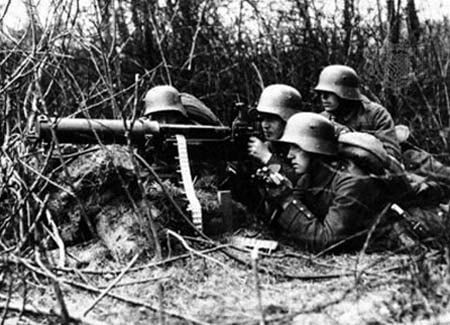
Comparative history has deepened our understanding of the First World War. Professor Jonathan Boff looks at the Western Front from the German perspective, throwing new light on the trench-bound struggle and the final German collapse in 1918.
Key takeaways
- 01Comparative history shows the Western Front looks very different from the German side of the wire.
- 02German commanders faced their own constraints and dilemmas in the trench-bound struggle.
- 03The German perspective helps explain the sudden collapse of 1918.
From the transcript
Well, actually, when you look at Rupprecht's diaries and the interactions that he has with both his superiors and his subordinates, what very rapidly becomes clear is that this idealised picture of this very sophisticated military machine is flawed on almost every level.
Throughout, certainly, the whole first half of the war, the French are the main enemy, not the British. … he's not as scared of the British as he is of the French, because he doesn't think that their generals are as good on the whole.
The point I feel quite strongly is that, without understanding the fact that the Germans are declining at the same time as the Allies are improving, you still can't really understand these battlefield outcomes.
But amongst the front line soldiers, they haven't given up. To me, the decisive moment comes when the army is told in early October 1918 that the Kaiser has sued for peace.
Full transcript
Read the full transcript
Music: Erik Satie’s Je Te Veux (piano/vocal)
Michael Baker
Welcome back to Unknown Warriors with me, Michael Baker. One of the clear trends in the emerging historiography of the First World War is towards transnational history, looking not just at how one nation was affected by the war but how other nations were too, and, just as importantly, how they made an impact on each other. Not surprisingly, the picture can begin to look rather different viewed from this perspective. This is especially true of the Western Front, where most of us have been used to a narrowly British point of view. I spoke to Dr Jonathan Boff, Senior Lecturer in Modern History at the University of Birmingham. Two of his books deserve particular attention here. The first, published in 2012, was called Winning and Losing on the Western Front. The other came out in 2018, and was entitled, Haig's Enemy, Crown Prince Rupprecht and Germany's War on the Western Front. Rupprecht spent the whole war as the Senior Commander on the Western Front. From August 1916, he was in charge of four German armies, comprising in total some 700,000 men. I began by asking Jonathan what had led him to approach the subject through German eyes.
Jonathan Boff
Particularly when it comes to the operational military history side, there tends to be a presumption that the experience of the British Expeditionary Force can be seen alone in a vacuum. And that, to me, just felt wrong. By definition, a war involves two sides. So, particularly over the last generation, there has been a reaction against the rather old and, I think, rather stale arguments about whether Haig was a good general or not, which had sort of consumed the historiography for two or three generations previous to that. And a bunch of very fine historians went back into the relatively newly opened archives, went through the records, and came up with this idea that the British Army on the Western Front had not been a bunch of either idiots or lions led by donkeys, but actually had managed, given the challenges that it faced, a remarkable transformation of itself in a very short space of time from the Army of 1914 to what it is by 1918, which is this highly professional, highly competent fighting force. But, the First World War being the First World War, the scale of the conflict being such, the scale of the sheer amount of material that one has to go through as a historian means that by the time you've done that for the British, you don't have an awful lot of time or energy left to go off and have a look at the French, from whom the British were also learning, much less the Germans. So what I wanted to do with both my books, but particularly with Haig's Enemy, was to try and look at the war from a German perspective, to find a German who was sufficiently involved that one could get a sense of what the war looked like through German eyes, not just through British eyes.
Michael Baker
So what kind of difference does that make to our understanding of events on the Western Front?
Jonathan Boff
Well, I think that there are a range of different myths that one can start to challenge or indeed dismantle. The first one is about the German army itself. The perception that one tends to have of the German army in the first half of the 20th century, not just in the First World War but in the Second World War as well, is that it's a very highly honed, well-honed tactical instrument. It's very good at fighting its battles, broadly. That it's very meritocratic, that it has a very flexible command structure, all these sorts of things. Well, actually, when you look at Rupprecht's diaries and the interactions that he has with both his superiors and his subordinates, what very rapidly becomes clear is that this idealised picture of this very sophisticated military machine is flawed on almost every level. That the command system is far from as flexible as it seemed to be. There were all sorts of cliques and infighting, getting in the way of operations. And that, in many cases, the weaknesses of the German army helped contribute to its own defeats. So that was one myth that I hope I have at least dented with Haig's enemy. I think a couple of others are to do with the earlier point I was making about the Anglo-centricity of a lot of the previous historiography, which is that actually when you look at the war through Rupprecht's eyes, well, frankly, he spends a lot more time worrying about the French than he does about the British. Throughout, certainly, the whole first half of the war, the French are the main enemy, not the British. And even in the second half of the war, when the British contribution has grown significantly, nonetheless, you get the sense that he's not as scared of the British as he is of the French, because he doesn't think that their generals are as good on the whole.
Michael Baker
So events and actions that loom large in the British perspective won't necessarily have the same significance for the Germans.
Jonathan Boff
Yes, so just to give you one example, the first day of the Third Battle of Ypres, Passchendaele, on the 31st of July 1917, which in the British accounts is seen as this sort of big climactic attack, which it was, you know, it was a big effort by the British. So the Germans, or to Rupprecht anyway, he hardly even notices it happened. The German defences, in his view, handled the situation perfectly well on their own, didn't need any reinforcements, no help from anybody else. This is a bit of a non-event from a German perspective. Now, as the battle goes on, that situation starts to change, and it does become more serious, as it were. But nonetheless, that first day is a very good example of exactly what you're talking about.
Michael Baker
The Germans had one important advantage on the Western Front. They were fighting in defence of territory in Belgium and France they had occupied early on in the war. Accordingly, once trench systems were established, they dug in and consolidated, constructing defence in depth. By contrast, the Allies were thrown onto the offensive, hoping always to push the occupiers back. How well, I wondered, according to their own records, had the Germans carried out their defensive tactic?
Jonathan Boff
Well, I think one has to say pretty well throughout most of the war. If you break it down by year, in 1915, there is very little that the Entente, the French and the British, can really do significantly to dent the German defences. Not because the German defences are perfect, they're not, they're continually evolving to make them stronger and better. But each time, every battle that is fought, you get the sense that the Germans learn a bit more from it than the Entente do, and therefore their defences are actually getting stronger, relatively, throughout 1915. In 1916, the situation starts to change. Verdun, obviously a failed attempt by the Germans to regain the strategic initiative on the Western Front. The Battle of the Somme, again, easily contained from a German perspective for the first few days, weeks. But as it goes on, and as the Entente manages to mobilise all the resources that one needs for modern industrial warfare, and the Germans start to feel the weight of that, well, you can feel that starting to exert some pressure on the Germans. 1917, in some ways, is a bit of a step back from the Entente perspective. The early failures, particularly the French army on the Chemin des Dames in May 1917, are clearly very painful. And then the Third Battle of Ypres never manages to put the Germans under the same pressure as the Battle of the Somme had done. The Battle of Cambrai in November and early December 1917, in some ways, marks a bit of a shift, because this is where the Allies are starting to put together the combined arms tactics that they will then use in 1918, eventually, to great effect. But the success of the Entente, the British, in innovating, as displayed on the first day of the Battle of Cambrai, is kind of vitiated by them making a lot of the same mistakes in the days thereafter, and then by the Germans having a very successful counterattack, which tends to get forgotten in the British narrative, in early December 1917. 1918 is a step change in the intensity of the war in every way. The decision by Ludendorff and Hindenburg, the German commanders, to try and win the war with a major offensive in the spring of 1918, using the forces that have been freed up by the collapse of Russia in the east, obviously fails, and it ends up weakening the German position such that the Entente, from July to November 1918, is able to start steamrolling back over the German defences the other way. So there is a final failure of German defences, obviously, in the summer and autumn of 1918, which is partly the result of internal German weaknesses, and it's partly the result of the attrition, just the sheer weight of the war, I think, by that stage, the number of casualties they've had.
Michael Baker
Of all these campaigns on the Western Front, the Somme has tended to attract most British attention, and mainly for the most negative reasons. So it's surprising to learn that for their part, the Germans felt that the Allied offensive, across much of their front, had overwhelmed their defences. And indeed, overall, the Somme can now be seen as much more of a turning point in the struggle than has previously been acknowledged.
Jonathan Boff
It doesn't matter how you measure success or failure on the First World War battlefield, there are all sorts of imperfect measures, ground gained, relative casualties, whatever, but whichever one you choose, the Entente doesn't come out of it very well, and they certainly did not achieve what it wanted to achieve with the Somme offensive, which was a major defeat of the German army. I think, however, it is possible to see in it some of, and only some of, the roots of the eventual outcome of the war. And I say that because I think at a pretty deep, strategic and conceptual level, it shows the Germans that this is not a war that is going to be won solely by tactical brilliance or being man for man better soldiers than the enemy. That there are other factors involved in this kind of a war, a war of attrition, that requires the total mobilisation of every resource of your country. And once the Germans realise that it's that kind of a war, it's very hard to see how they could possibly win it, given the preponderance of economic, industrial, population, all these different forms of strength that lie with the Entente and, of course, with the United States of America. Now, one could say, and I would, in fact, that Germans, jolly well, should have realised this a bit earlier and they could have saved everyone an awful lot of trouble and grief. But they didn't. But the Somme starts to bring it home. And you do get a sense, really, that the German High Command in particular is rocked by the intensity of the fighting, not on the 1st of July 1916, but by the ability of the Entente to keep coming at them repeatedly, particularly through September, October, even into November 1916, when the weather has turned very far for the worst. You get this sort of sense of, you know, when's this ever going to stop as it wears down more and more of the German reserves and the German army. And this stress shows itself in very obvious ways. For instance, in August 1916, the removal of Falkenhayn, the chief of the general staff, and replacement by Ludendorff and Hindenburg, and the way that Ludendorff and Hindenburg tried to remobilise the German nation.
Michael Baker
Some historians who have studied the German archives have suggested that the Entente lost any element of surprise at the Somme because of their careless communications, and even admissions by prisoners of war captured by the Germans. Was there any truth to this?
Jonathan Boff
It was so difficult and required so much resource to prepare for one of these offensives that the enemy had to be deaf, dumb and blind not to realise that something was coming up most of the time. Now, as the war goes on, the Entente become better at hiding those preparations. That's undoubtedly true. In 1916, on the Somme, for example, or indeed in 1917, for most of 1917, the idea is that the only way to get your infantry across no man's land and into the enemy trenches is to shell the hell out of it in days and days on end, which of course makes it absolutely obvious to all concerned that an attack is coming. What Cambrai does with the introduction of what they call unregistered artillery fire is it allows for the possibility of surprise again. So one can replace these very long, slow, obvious artillery bombardments with short, sharp, very intelligence-driven artillery fires, which can coincide with your attack rather than preceding it. On which point, it's worth mentioning, the sheer amount of kit, I mean, literally trainloads and trainloads and trainloads, of artillery shells that are required for bombardments, such as the one in the lead-up to the Somme, on its own would be impossible to hide, even if the guns had never fired a shot.
Michael Baker
Artillery, and heavy guns in particular, certainly seems to have been one area in which the Germans consistently felt they were at a disadvantage to their enemies. How real was that disadvantage, and how did it affect the Germans' fighting capability?
Jonathan Boff
I think it's fair to say that they felt overall that they were at a material inferiority. Heavy artillery was certainly one aspect of that, and the shells for heavy artillery, but it also extended to aeroplanes, tanks, all the sort of kit and caboodle of war. They felt they had less of than the enemy. To what extent that fed over into morale problems? Well, it's pretty hard, frankly, to reconstruct. There is a caveat that one has to make with all this stuff, of course, which is that everyone always thinks they haven't got enough stuff, and you can find just as many British generals complaining about a shortage of heavy artillery at various points during the war as well. So, you know, I think one has to at least see them in the context of the missions that were required. You know, the Germans didn't need as many shells as the Allies in 1916 and 1917 because they were on the defensive and they had an easier job.
Michael Baker
Looked at from Rupprecht's point of view, it's clear that certainly from the Somme onwards, when every German division was losing a third of its infantry each time they served in the front line, the Germans had an increasingly worrying manpower problem, which was only likely to get worse as the war dragged on.
Jonathan Boff
The combined populations of Austria, Hungary and Germany are significantly less than Britain, France, Russia and the United States put together. So the Germans can't afford to lose men at anything approaching the same rate as the Allies do. And therefore, although they tend not to lose as many men as the Allies do in the course of the war, they do start to run out of them, as you say, from the end of the Battle of the Somme onwards. Now, what I mean by running out of men is not necessarily that there were no men left, but increasingly that the quality of the men that were available was deteriorating. And what that means is it has several impacts. First of all, the overall morale of the force starts to suffer, or becomes more vulnerable. Secondly, it means that command and control, which in an ideal world, given the poor state of communications on the First World War battlefield, would be delegated as far as one possibly could, it becomes harder for the senior commanders to feel the confidence in their men that enables them to do that. So you tend to get a sort of creeping arthritis that comes into the whole command setup with increasing centralization, which makes the army more predictable to its enemy and much less flexible, both in the attack and the defense. Alexander Watson's written an excellent book in which he actually goes a step further than that and says that the declining quality and morale of the German soldier and the declining numbers means that the small pockets, who increasingly are occupying shell holes in no man's land rather than continuous lines of trenches as the war goes on, are more isolated from effective command and control. There are fewer NCOs and officers around to keep an eye on them and therefore, certainly by 1918, it becomes much easier for those isolated pockets to raise the white flag when they're attacked than it had been earlier in the war when they were under more effective control and the men themselves were better motivated. So, you know, as everything with wars and military history, it's all interconnected, but it has effects at multiple affront levels. Throughout the armed forces, never mind, obviously, the impact that it then has on industry as the best men are being combed out to send to the front.
Michael Baker
The German retreat in early February 1917 to the Hindenburg Line, a stronger and shorter front to defend, was certainly one sign of the strain on their manpower.
Jonathan Boff
The purpose was twofold, threefold perhaps. One was to dislocate the Entente. Because of all the preparations that were required for an offensive, they didn't want to stay in the same places they'd ended up in 1916 because it would be too easy, they thought, for the Allies to launch an offensive from that point of view. That's the first point. The second point is precisely yours, which is that shortening the line enables them to reduce the manpower that needs to hold that line, gives them more reserves, gives them more flexibility. And the third point is that this is in itself a symptom of how badly rattled the Germans have been by the Battle of the Somme. They've realised they cannot stand and fight this kind of battle without having better fortifications, proper reserves, all sorts of things that they hope to create by moving back to the Hindenburg Line.
Michael Baker
The consensus now about Allied victory on the Western Front is that through a costly process over four years, the so-called learning curve, they improved sufficiently as a fighting force to defeat the Germans in 1918. The German perspective provides a slightly different take, suggesting that this outcome owed as much to the German army getting worse over time as the British and French getting better.
Jonathan Boff
What is striking, and it's something that I hope came through strongly in my first book about winning and losing on the Western Front, is that if you look to the end of the war, expecting to see consistently high standards of military performance across the whole British Expeditionary Force, you're disappointed. Because it just isn't like that. It's much patchier. For every unit that has got the idea of how to fight modern warfare 1918 style, there is another one that is still blundering around and might as well be back in 1916 to some extent. So if there are learning curves, they're not single, uniform, consistent learning curves. It's a more complicated picture than that. But, that said, the overall effect of the British army, you can't get away from it, is definitely more positive than it had been in 1916 or 1917. So, to some extent, the idea of the learning curve must be true for all the caveats that I'm trying to impose. The point I feel quite strongly is that, without understanding the fact that the Germans are declining at the same time as the Allies are improving, you still can't really understand these battlefield outcomes.
Michael Baker
That said, Jonathan is pretty critical of the German high command, and not just under its war leaders, Falkenhayn, Hindenburg and Ludendorff, but also in its planning in the years leading up to 1914.
Jonathan Boff
Yes, I think it's flawed on almost every level. Let's just start with the most important. This was a war that should never have been fought. The first and most serious strategic failure of the German military happens before the war even begins, and it's when the army effectively says, the political problem that faces Germany of encirclement, which is how they saw it, by France and Russia particularly, can be solved by military means, and the Schlieffen Plan is the solution, with the German army as the tool.
Michael Baker
The Schlieffen Plan, first drawn up in 1905, envisaged a lightning German offensive that would defeat France in the west before Russia had effectively mobilised in the east. This plan was essentially the one the Germans used in 1914.
Jonathan Boff
Straight away, that raises the prospect of a quick, successful war which will solve the German question so far as Berlin is concerned. Now, I don't think that was true at the time. I think if they had thought about it very hard, they would have realised that wasn't true. Even if they thought it was true, they failed to create a proper integrated plan for how this is going to work, so that there's no thought given to what the political settlement of France would be after this military victory. Much more like the Bush-Cheney plan for the invasion of Iraq in 2003. And while it's all very well to say, first catch your hare, you've got to have some kind of idea, surely, of what you're going to do with that hare once you have caught it. So strategically, they're starting from the wrong places and then they fail to be honest with themselves or with the politicians at almost any point throughout the rest of the war about the situation. Because even if we accept that the Schlieffen Plan could have worked, well, once the Battle of the Marne had been lost, it was clear that it happened and that any prospect of this quick, decisive victory on one front that would then enable them to concentrate against the Russians had failed. So they're consistently making the wrong strategic decisions. And that applies all the way through to the German Spring Offensive in March 1918, which is, I think, also equally ill-conceived. Or it's a gamble. A gamble that failed. And then, in the autumn of 1918, they misjudged their own forces, they misjudged the enemy forces, and then start lying about what's about to happen. You need to put the blame on the home front rather than the soldiers, which has horrendous consequences for German history, which you don't need to know much about German history to understand.
Michael Baker
This conceptual flaw by German military planners had its roots in a broader militarised German culture.
Jonathan Boff
Ironically, given that Clausewitz was a Prussian, they forget that war is the continuation of politics by other means, to use his phrase, and therefore that you always have to have an eye to what the political consequences of your military actions are likely to be, and have a political plan to back up the military plan. So you have a failure of the civil-military interface, if you like, which is problematic. And then the second one is something that Isabel Hull has identified in her book, Absolute Destruction, which is a natural tendency within the German military towards what she calls military extremism. The idea being that because Germany, from the time of Frederick the Great onwards, or indeed before, has been used to the idea of having to win quickly in short and lively, was Frederick the Great's phrases, kurz und vives wars, wars, the culture of the German military is set up to establish this fight hard, fight fast, fight dirty if need be, but make sure you win in a short period of time, because Germany can't survive a long war with enemies on all sides. Isabel Hull's point is that that then creates a culture, particularly within the German military, which says, take the gloves off if necessary. And indeed, not only take the gloves off, but escalate, escalate the violence that you deploy. If you face opposition, well then be ruthless in exterminating it.
Michael Baker
Something of this ruthlessness was seen as the German army swept into Belgium and France in August 1914. Atrocities by the enemy were often exaggerated by the other side, but we now know that those carried out on Belgian and French civilians at the start of the war were real enough.
Jonathan Boff
There's a very interesting book by John Horne and Alan Kramer called German Atrocities of 1914, which documents these in detail. I think their estimate is that over 6,000 French and Belgian civilians were murdered by German soldiers. And what's happening is that the German army in 1914 is trying to avoid the problems that they perceived as having occurred in the Franco-Prussian War of 1870-1871, when there were large numbers of what they saw as French civilians taking potshots at their soldiers. Of course, some of it's confusion and just the friction of war, but some of it's pretty deliberate, and it is precisely to say we are not going to tolerate any level of civilian opposition to the progress of our armies. And so they're trying to intimidate the Belgian and French populations from the off. Now, as it happens, the war settles down in a completely different way, of course, and you end up with this depopulated zone either side of the Western Front extending back 20 miles or whatever it is. So actually the level of interaction between civilian population and armies for most of the war therefore falls away. Consequently, the number of atrocities fall away too.
Michael Baker
Finally, I wondered at what point the Germans on the Western Front think they had lost.
Jonathan Boff
I think it depends who you're talking about. There are some people who start to see even as early as 1916 that they're in trouble. Rupprecht is one of them some days, but he's a bit up and down. There are also days even up until April 1918, March, April 1918. It's really not until he realises that this big gamble of the spring offensives has failed that he then realises that we are finally, without any question, going to lose this war. But equally, there are others who think they can carry on a lot longer. I think Ludendorff kind of realises it about August 1918, but doesn't really admit it until October. Individual soldiers, well, this is, you know, it's quite a vexed question in the historiography. A lot of people have written a lot of stuff about when and if the German army has a meltdown of morale in 1918. My own view is that certainly amongst the front lines soldiers, it actually holds up remarkably well, considering. There are problems in the rear areas, there's no question about that. But amongst the front line soldiers, they haven't given up. To me, the decisive moment comes when the army is told in early October 1918 that the Kaiser has sued for peace. From that point onwards, with the exception of a few very brave men who are prepared to carry on fighting to let their comrades get away, thereafter, I think you can see morale fall off pretty sharply. But it's surprisingly late considering the overall situation. Partly, of course, because there was a lot of censorship, people weren't being told the truth. The army was definitely not telling the truth to the Reichstag, for example. The Kaiser was neither the man nor in a position to stand up to the army about this and demand better answers than he was being given. But, then again, there are housewives in Vienna or in Munich who, as early as the beginning of 1918, realise that the situation is so bad that they're unable to feed their families and to that extent the government is failing in its number one job as far as they see it.
Michael Baker
And were the soldiers at the front aware of that situation back home?
Jonathan Boff
Yes. So there's a feedback loop. It's very hard to untangle exactly who gives up hope when.
Michael Baker
I've been talking to Dr Jonathan Boff, Senior Lecturer in Modern History at the University of Birmingham. If you want to know more about Jonathan's work or related topics, please follow the links in my website www.unknownwarriorspod.co.uk In the next episode of Unknown Warriors, I shall be looking at some of the ethical issues raised by the First World War and how red lines set up internationally before the war were swiftly overrun as the conflict progressed. I hope you'll rejoin me.
Music: Satie’s Je Te Veux
Michael Baker’s narration in italics. This transcript was made automatically from the audio and may contain errors.