The question
Was the Western Front really a futile slaughter?
The popular British narrative depicts the Western Front as wasteful and futile. Professor Gary Sheffield shows this was a war that had to be fought and won, and that the Allies overcame their mistakes to inflict a decisive defeat on Germany.
Key takeaways
- 01The Western Front was a war that had to be fought and won, not a futile exercise.
- 02The Allies learned the hard way how to fight in unprecedented battle conditions.
- 03By 1918 they had overcome their mistakes to inflict a decisive defeat on Germany.
From the transcript
We know what Douglas Haig was doing at exactly midday on the 1st of July 1916 … He was catching up with routine paperwork … The other way of looking at it, it was as good a use of his time as any because he did not know what was going on.
Rawlinson, I think, is the villain of the piece when it comes to the 1st of July 1916, the first day of the Battle of the Somme, not Haig.
It's been well said by my Wolverhampton colleague, John Bourne, that Britain in 1918 was fighting a rich man's war. Unlimited supplies of bombs, shells, tanks, guns. They had been fighting a poor man's war earlier.
So taking Haig as a whole I certainly would not argue that he's one of the world's great generals … So general he's okay, war manager I think he was rather good.
Full transcript
Read the full transcript
Music: Erik Satie’s Je Te Veux (piano/vocal)
Michael Baker
Welcome back to Unknown Warriors with me, Michael Baker. In our first podcast, we looked at the bigger picture, at how the traditional view of the First World War is now being challenged and revised by professional historians. In this episode, I want to turn my attention to the Western Front, the particular preoccupation of British historians, and perhaps in Britain, the most enduring source of the war's popular appeal, albeit for mostly negative reasons. I spoke to Gary Sheffield, Professor of War Studies at the University of Wolverhampton, and a leading military historian who has written extensively on the First World War. He's perhaps best known for Forgotten Victory, published in 2001, which asserted that the First World War was neither futile nor meaningless, but had to be fought and won. And more recently, during the centenary, for a new biography of Douglas Haig called The Chief, Douglas Haig and the British Army. I began by asking Gary how British involvement on the Western Front has been viewed in the historiography. He made it clear that scholarship has taken a very different path to the more popular narrative.
Gary Sheffield
The dominant popular image of the Western Front could be summed up by the phrase lions led by donkeys. The idea that the generals were completely clueless, that they had no better idea than how to overcome the deadlock on the Western Front than by simply throwing troops at machine guns and trenches over and over again. The lions, of course, being the soldiers, the donkeys being the generals. Fiction probably has been at least as important as history in this respect. So I'm thinking of Oh, What a Lovely War, the semi-improvised play in the early 1960s, which turned into a film by Richard Attenborough in 1969. And, of course, a whole new audience for this interpretation came with Blackadder, Blackadder Goes Forth, in 1989. But it's not just fiction. It's very interesting that the BBC Great War series, which came out in 1964, two of the principal scriptwriters were John Terraine and Correlli Barnett, both of whom actually were among the very few historians at that time arguing against this received image. And the Somme episode of the Great War TV series actually is, by modern times, actually quite revisionist in its views. And yet people don't seem to have noticed that John Terraine's script was going away from this lions led by donkeys approach, because it seemed to be overwhelmed by the images of death and slaughter and wounding and the use of poetry. So actually the revisionist message got rather buried, although it's certainly there if you want to look carefully. And so down to the present day, I would say, at least some form of lions led by donkeys is the dominant popular view of the fighting on the Western Front.
Michael Baker
So how did academic historians start to challenge this dominant popular narrative?
Gary Sheffield
The opening of many public records for the Western Front, such as War Diaries in 1968, that made possible a generation of research students who were examining not what people had written about the First World War. So, for example, private memoirs and a few private diaries and what have you, which had come onto the public domain like Haig's. But it went away from that to actually reading the official documents. You could actually read war diaries, after-action reports, planning documents. All of this made a fresh approach to the military history of the Western Front possible, because suddenly you're actually looking at primary source material that was not being mediated through some other source. There's also, I think, a turn against some of the old-school approach to the First World War, which is discernible in the late 1970s and comes to fruition really in the 1980s. Actually, I guess with my generation of PhD students. So many of the leading figures in the military history of Britain and the First World War, people like Hew Strachan, Brian Bond, actually were working on this field together with a younger generation. A particularly influential historian at the time was Tim Travers. His big book, The Killing Ground, was published in, I think, 1987. Came up with quite a damning view of the British Army and Haig, but nonetheless it was one that was based on solid archival research, rather than memoirs and so on and so forth. Since he wrote in the 1980s and early 1990s, there has been more intensive research into the documents. And for me, looking specifically at the British Army and the Western Front, two books stand out as being seminal. The first one is a book by two Australian-based historians, Robin Prior and Trevor Wilson, Command on the Western Front, which came out in 1992. It's basically a military biography of General Sir Henry Rawlinson, Commander of the Fourth Army in 1916 and 1918. And again, it's actually in many ways quite critical, but it actually shows there was definitely a learning process in the British Army. And comparing the Army of 1916 with 1918, it shows exactly how much the Army had learned, the things they'd got right, the things they were still getting wrong, but nonetheless, in my view, a seminal book. The other one is a book called Battle Tactics of the Western Front, published by Paddy Griffith. This, I think, did an excellent job in showing, again, how much was learned as the war went on. By no means a smooth upward curve. The phrase learning curve has actually rather gone out of favour recently, in favour of learning process, which actually, I think, is a better description. Those two books, for me, were absolute game changers. All sorts of stuff has come out since, but I think those two books are the ones in which I still regard as being the foundation of modern scholarship of the British Army in the First World War.
Michael Baker
What seems to have emerged now is a much more nuanced picture of the Western Front, as an unfamiliar and highly challenging combat environment to which all the armies involved had to learn to adapt the hard way. Not least the British Expeditionary Force, by far the smallest of the big power armies in Belgium and northern France in 1914.
Gary Sheffield
The British Army in 1914 was utterly unprepared for the sort of war that it found itself fighting. It actually was, I think, a pretty good army at what today we would call counterinsurgency. Then they called it small wars. It had come out of the Boer War having, again, learnt an awful lot, fighting against, for the most part, an elusive guerrilla enemy in open terrain, very different from coming up against a first-class enemy of an industrialised nation in a Western European setting, so Belgium and northern France. On the retreat from Mons in August 1914, it rapidly became clear that the two corps that the British Expeditionary Force were divided into, one commanded by Haig, second corps commanded by Smith-Dorrien, simply could not remain in contact while they were on the march. In effect, they were two completely separate armies doing separate things. And this problem of communication was written even larger, but in a different way, when trench warfare set in and war became static. The basic problem was that in the First World War, there was really no voice control by high commanders. So, a hundred years before, Battle of Waterloo, Wellington or Napoleon could either physically ride up to their troops at Waterloo and give orders, or they could dispatch riders to ride a mile and a half, two miles maybe, to give orders. The problem is, by 1914, armies are far too big and too dispersed to have that sort of voice control. Now, 25 years later in the Second World War, the same basic problem in theory actually was overcome because there was sufficient development in terms of wireless communications for a commander like Montgomery or Rommel actually to stay in their headquarters and keep in touch with frontline units through radio. Now, by no means was it always straightforward, but it was possible. But in the First World War, you could neither command armies, large armies in person, neither did you have the technology to command them by radio. And generals are often criticised for staying back behind the lines. The phrase chateau generals has been used to sort of dab an entire generation. Now, like all sort of good myths, it's got a grain of truth. Staying back behind the lines did, to some extent, isolate commanders and even alienate commanders from their troops underground. But the truth is that if someone like Haig or Ludendorff or Pétain, if they had actually gone forward to command in the front line, they would demote themselves basically to second lieutenant because the only people they could command were those that they could actually physically hear them shout. So the most sensible place for a commander to be was back in the rear where they could be found by messengers. More importantly, where a telephone exchange could be installed, which normally is a big place like a chateau. The irony is that once trench warfare had begun, so the front solidified, it was easier for high commanders to stay in touch with front line troops than ever before because they had a very elaborate telephone network which stretched from GHQ all the way ultimately to the soldier in front line trench. The problem is, the moment they got out of that trench and advanced across no man's land, they had to leave their telephones behind because they relied on wire. So it's really only towards the end of the war when portable radios, still pretty big, but just about portable radios, became available. Did it become possible for some sort of radio contact between higher headquarters and the front line? But again, there were a few of them. It was pretty unreliable. It had to wait really to the Second World War for this system to be up and running. So the one big problem faced by all commanders in the First World War was lack of communications. How could you possibly know what was going on to intervene in the battle if you had no information? One example of this I found in the course of my own research. We know what Douglas Haig was doing at exactly midday on the 1st of July 1916, the first day of the Battle for Somme. He was catching up with routine paperwork. Now we know this because there is a letter he wrote to someone at home and he not only dated it, he put the time on it. Now, at one level, this seems appalling. You know, there's this dreadful battle going on, men being killed and wounded in their thousands and Haig's catching up with the paperwork. The other way of looking at it, it was as good a use of his time as any because he did not know what was going on. He was unable really to do anything to interfere in the battle, either positively or negatively, until some information reached him. And at midday, he had nothing to go on.
Michael Baker
An earlier battle fought on the Western Front that has been much studied by modern military historians was Neuve Chapelle, the first major British trench offensive of the war in March 1915. This came tantalisingly close to a British breakthrough and British commanders sought to apply its lessons to subsequent battles.
Gary Sheffield
Neuve Chapelle was indeed a very influential battle. It was fought in March 1915. I mean, the essence of the story is the British broke through the frontline German defences but were unable to rush up reserves in time to exploit it and break out properly. Germans threw in reserves, sealed the gap, and the battle ended up, in effect, with a draw. The British gained some ground but hadn't broken through. Now, the British High Command go into this in some detail and they come to several conclusions. One is that, actually, they had almost broken through. There is some truth in that. But the problem was that reserves were not at the right place at the right time. So, therefore, they were unable to exploit the advantage which had been gained. That, of course, is also true. However, what they failed to realise, because they basically had the idea where, OK, well, we'll fix that next time to work, they failed to realise that the Germans on the defensive were learning exactly at the same rate as the British were. So, just as they sort of thought they had fixed the problem from Neuve Chapelle, the Germans had actually improved their defensive tactics. And so, the next attack, actually, was an utter disaster, the Battle of Aubers on the 9th of May. But, people continue to look at Neuve Chapelle. Haig, in particular, is extremely influenced by Neuve Chapelle. He's actually becomes fixated on the need to take advantage of fleeting opportunities. He thinks they've been thrown away in the Battle of Neuve Chapelle. And so, that influences his planning for the Somme, and indeed for later campaigns, where he's always keen to have his reserves up close and ready to intervene. Now, Haig has come in for some criticism for this, because this normally means bringing cavalry up to the front line. And cavalry's got a very bad reputation on the Western Front, not entirely deserved, but I think the point to take home here is at this stage, there are no other forms of mobile, even semi-mobile troops available. So, it's cavalry really or nothing. The other thing which actually possibly should have been more influential for Neuve Chapelle, but isn't, is that Neuve Chapelle is heralded by a hurricane bombardment, that is, a very rapid shelling of the German positions, rather than a slow, methodical shelling. And initially, that works quite well. They try to, at subsequent battles in May and the spring of 1915, it doesn't work so well. They go back to the slow, methodical approach, as we see at the beginning of the Somme. It's only really at Cambrai in November 1917, when they return to the Neuve Chapelle method of a very rapid, very violent bombardment. And that proves to be highly successful.
Michael Baker
Haig's fellow commander at Neuve Chapelle was Sir Henry Rawlinson. Rawlinson was an exponent of bite and hold, an operational tactic that would become important in later Allied success on the Western Front.
Gary Sheffield
Well, bite and hold is essentially a limited offensive. So you take a bite out of the enemy position, basically by lining up the artillery, shooting the infantry forward, the infantry occupy territory, but then stop. They don't attempt to break through or exploit. They stop, they dig in, they allow the enemy to counterattack, you smash up their counterattacks, the idea being that you basically combine the advantages of the attacker, that is seizing the initiative, that of the defender, they're coming onto your guns. Then you do the same thing all over again. Now, Haig has been written off as someone who's opposed to bite and hold, always seeking a breakthrough. My reading of that is slightly different. Ultimately, Haig is aware that a breakthrough is what is to be needed to bring a war to a swift conclusion. He's not entirely right about that, but you can see it's not an unreasonable view to take. And my view is that actually he seeks to combine bite and hold with breakthrough. So the Battle of the Somme, in my view, wrongly, has been categorized as a sort of conflict of two ideas. Haig's breakthrough, Rawlinson's bite and hold. Actually, if you look at Haig's plans, you know, he'd be quite happy if they did manage to break through on the 1st of July. But he's fully aware that might not happen. And there is a plan B, which is basically to fight it out and gradually grind down the enemy in a form of attrition, a form of bite and hold, if you like, until that reduces the Germans to a point at which you can once again launch a major attack and attempt to break through. And in fact, he hedges his bets really throughout 1916 and 1917. He's always got a plan B of attrition, which involves bite and hold up to a point. Rawlinson, I think, is the villain of the piece when it comes to the 1st of July 1916, the first day of the Battle of the Somme, not Haig. All sorts of things you can say against Douglas Haig's Somme plans. But actually, had Rawlinson worked within the spirit of them, there was a chance for, not a breakthrough, but a substantial advance on the 1st of July, which was thrown away because Rawlinson was too wedded to bite and hold. And that brings me back to my final point on bite and hold. Limited attacks are going to bring about limited success. That's the very nature of the beast. There were some occasions on which that was simply not enough. They should have built on that. And essentially, that's what Haig was seeking to do, to build on bite and hold, to go further than that, and eventually turn it into a breakthrough. Didn't happen in 1916 and 1917. It did up to a point in 1918. I think the basic idea was correct, but they simply did not have the wherewithal. They did not have the technology, which existed 20 years later in the form of fast, reliable tanks, mobile infantry and all the rest of it.
Michael Baker
But no operational method in the field could be sustained on the Western Front without the required level of logistical support. For example, had the rapid advance to Allied victory in the summer and autumn of 1918, the so-called 100 days, been any faster, they would simply have outrun their supplies and ground to a halt.
Gary Sheffield
In the spring of 1918, when the Germans attacked and broke through, to oversimplify, the Germans just kept going until they ran out of steam. It meant that they were at the end of very long, tenuous supply lines. And having to hold large tracts of territory which, frankly, were indefensible against larger forces. The Allies, on the other hand, under the overall command of Marshal Foch, did not make that mistake. Their advances were quite shallow, maybe eight or ten miles. They were properly sustained by logistics. And once they were brought to a halt in one area or they'd run out of supply, they would switch the point of attack. They kept pushing the Germans all across the front until sooner or later the German line collapsed. Now, an important point to note about that is they could do that in 1918 because their logistics were significantly superior to that of even a year earlier. So they had far more trucks, they had light railways, and from a British point of view, what made a huge difference was that their programme of production of heavy guns had been completed, started in 1915, had been completed by the spring of 1918. And so they had pretty well a complete artillery park for every army, of which there were five. You did not have to shuttle numbers of guns up and down the line, which was difficult and laborious. The Germans were still doing that in 1918. The British had to do that in 1917. But in the hundred days of the autumn of 1918, the British had so many guns, they simply did not have to put such a strain on the logistics system. It's been well said by my Wolverhampton colleague, John Bourne, that Britain in 1918 was fighting a rich man's war. Unlimited supplies of bombs, shells, tanks, guns. They had been fighting a poor man's war earlier. The only thing they did not have in abundance by 1918 was manpower. But in terms of weapons of war, munitions, the British basically had as much as they could need. The best example of this is the attack on the Hindenburg Line by the 46th North Midland Division, Australians, Americans, various other forces, on the 29th of September 1918. And this is the breaking of the Hindenburg Line, one of the most famous actions of the war. I think very indicative because the 46th North Midland Division is a territorial division, so pre-war part-time soldiers, those that are left, plus volunteers, plus conscripts. Not an elite division. It had actually done really quite poorly in two previous battles at Loos in 1915 and on the Somme in 1916. And yet, its quality of personnel, training, doctrine, all the rest of it, was good enough when supported by a bit of good luck, some excellent low-level leadership, and a phenomenal amount of firepower to get them across the St. Quentin Canal to break the Hindenburg Line. British 4th Army fired just under one million shells during the assault of the Hindenburg Line, and they were replaced within a few days of the battle. It's a different league from the numbers of shells available at Neuve Chapelle three years before.
Michael Baker
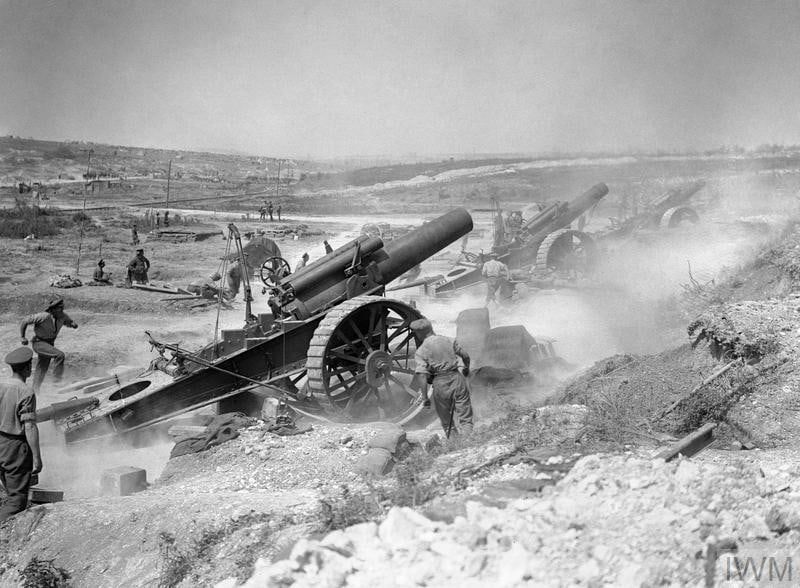
It would be true to say that firepower, on an industrial scale, particularly the use of big guns, was a defining characteristic of the war on the Western Front, causing around 70% of battlefield casualties, and as men were blown to bits by exploding shells, almost wholly responsible for the endless lists of the missing. But in such a war, the guns, their numbers, their reliability and their accuracy could make the crucial difference between stalemate and advance.
Gary Sheffield
Well, in the First World War, artillery was a battle winner for the British Army, as it was in the Second World War, actually. There were many continuities between the two wars. And the artillery went into the war fairly unsophisticated. The artillery was divided into three branches, horse artillery, which was the socially elite bit, the royal field artillery, which was the main bit, the royal garrison artillery, which manned the heavy guns. And of those three, the garrison artillery were the scientific branch. And they were looked down upon as beings of inky-fingered swots by the other two before the war. And yet, by the middle of the war, the entire royal artillery was a thoroughly scientific organisation, applying science in a very practical way. The major scientific development of the war, in many ways, was the bringing together three pieces of pre-existing kit, kit that existed in 1914, that is, the gun, the field gun, or howitzer, the radio set, or wireless, and the aeroplane. Now, put those three together, you have an aeroplane flying over enemy positions with an observer, with a radio set, sending back messages to a station on the ground who are relaying them to the guns, basically spotting for the artillery, so therefore, you know, telling the gunners, you're firing too far to the left, you're firing too far to the right, what have you. And of course, spotting targets is vitally important. Jonathan Bailey, a retired British Army officer and historian, has called this the birth of modern warfare. His argument is that warfare is fought in two dimensions in 1914, but the addition of air allied to artillery makes it a 3D war. And certainly, what the use of the aircraft does is enable commanders and gunners to look literally and metaphorically over the other side of the hill. So now, nowhere on the battlefield that's within range of enemy artillery is safe, is free from being bombarded. And of course, this in turn brings about the battle for air supremacy. So air forces basically create the roles they use today over the Western Front in 1915, 1916. Airplanes in 1914 are purely about reconnaissance. Many of the early ones aren't even armed. Rival pilots see each other fly past, they wave at each other. Later on, they try to shoot each other with revolvers. By 1915, certainly by 1916, by the time of Verdun and the Somme, aircraft are being used to try to dominate the sky. And what's the purpose of this? Basically to try and prevent the enemy sending his reconnaissance planes over your lines while simultaneously driving back the enemy aircraft to allow your planes to get over the other side. So the whole, you know, glamour of the air war, you know, Von Richthofen, Albert Ball, all the rest of it, these dogfights and air aces, ultimately, it's all about clearing the way for the slow, the RE8 was the British reconnaissance machine to chug up and down the German trenches, taking photographs and radioing information back to the ground. So actually, artillery creates not merely a new form of land warfare, it creates the entire purpose of tactical air warfare as well. Later on in the war, of course, you have aircraft being used to attack ground targets, to bomb and to strafe and everything, but the basic purpose of a tactical air force in the First World War is to spot for the artillery because artillery is the absolute battle winner.
Michael Baker
The unreliability of communications on a front where mass armies were deployed over large areas meant that command had to be delegated locally. Even in 1914, this was official army policy, but the reality was much harder to achieve.
Gary Sheffield
If you look at the doctrine with which the British Army went to war, Field Service Regulations 1909, amended and closest to war, the doctrine for command is known as the man on the spot. It's basically devolved command, the idea being that given that the commander cannot possibly know what is going on at all parts of the battlefield, you actually leave it to the man on the spot to take action within the parameters of the commander's plan. This has got a remarkably modern ring about it. Today, the British and American forces know it as Mission Command. The problem was, at the beginning of the First World War, not everybody was signed up to it. It was very much Douglas Haig's baby, incidentally. He was responsible for the writing of Field Service Regulations. A very good example of it working is in the retreat from Mons, when separated from Sir John French, both Smith-Dorrien of Second Corps and Haig of First Corps basically worked out their own salvation and did it pretty effectively. A very bad example of it is in the landings at Gallipoli in April 1915, the British landings at Cape Helles. Two battalions landed on Y Beach at Gallipoli, faced no opposition, made no attempt to march towards the sound of the guns. They just stood there until the Turks came up and sealed them off and basically they wasted the opportunity. And so this is the problem, that the doctrine is there but not everybody buys into it. Now what I think does happen in the course of the war is that increasingly you get a meritocracy emerging. That is, commanders who are not necessarily pre-war regular officers start to emerge from the pack and they're promoted because they're good at what they do. Now there's always a bit of a glass ceiling. It's very difficult for a non-regular pre-war professional officer to make it any higher than brigadier level even though there's only a few of them. But nonetheless you see all sorts of people emerging. There's one chap who before the war is the chief education officer for Nottinghamshire who emerges as a really effective commander. You have pre-war sergeants being commissioned and commanding battalions on the western front. So you actually you do get I think a real change in terms of personnel. Now allied to this is a greater understanding of what today we would call mission, command or man on the spot doctrine actually means. When people are comfortable with the doctrine when they've grown up in it then actually it begins to work quite well. And so in 1918 indeed before that you've got some very good examples of commanders you know taking decisions and actually going on and doing things without orders. You actually now get down to senior privates. I mean it's entirely possible in a battle like Passchendaele all of the NCOs and officers might be killed or out of action at which point a senior private will take control and basically they know what to do at this stage. And you can see this battalion level brigade level divisional level it's very much part of the culture. The problem is as the work of people like Jonathan Boff have shown in recent years it's patchy. You find some formations where this is extremely good where there's a lot of devolved command in reality as well as in theory in others that culture simply isn't encouraged. So in 1918 there are some parts of the army which are very good at doing this sort of stuff others which are not good at all.
Michael Baker
Finally I asked Gary as Douglas Haig's latest biographer how he would assess him as a general. He acknowledges Haig made mistakes some of them very costly. So where does his reputation stand now?
Gary Sheffield
The problem trying to compare Douglas Haig with anybody else is there's very few people who did the same job as he did. Certainly there's no one else in British history who commanded forces on the same scale as Douglas Haig so you can't compare him with Wellington or compare him with Montgomery because both of those forces were a lot smaller. Comparing Douglas Haig with any other general apart from the First World War period is really quite difficult because Haig was a war manager above all else. Commanding the British Expeditionary Force in other words operating as in effect an army group commander that is taking operational decisions which make a difference in the battlefield was only part of his job. He was also the senior British commander in France so therefore he had to deal with his allies like the French and with the government. He's also a theatre commander which means that he was responsible for ultimately everything including discipline and logistics and morale. It's just an absolutely huge job and I think Haig is one of a new breed of war managers and you can compare him with Hindenburg or Ludendorff on the German side, maybe Pétain or Foch on the French side so actually he's only got a very small peer group and it must be said in that company he does not emerge at all badly. He ultimately is a winner, he certainly makes mistakes, he makes erroneous strategic decisions but nothing like as disastrous as decisions that Ludendorff makes, particularly in 1918. So taking Haig as a whole I certainly would not argue that he's one of the world's great generals. He was a decent enough general but I would say that the burden he bore as a war manager was absolutely formidable and he acquitted that side of his job I think extremely well. So general he's okay, war manager I think he was rather good.
Michael Baker
I've been talking to Gary Sheffield Professor of War Studies at the University of Wolverhampton. If you want to know more about Gary's work on the First World War please follow the links on the website www.unknownwarriorspod.co.uk In the next episode of Unknown Warriors I turn my attention to the German experience of the Western Front, often very different from the British or French. I hope you will rejoin me.
Music: Satie’s Je Te Veux
Michael Baker’s narration in italics. This transcript was made automatically from the audio and may contain errors.