The question
How did the First World War break the rules of war?
Before 1914, international rules were established to govern the conduct of war. Diana Preston explains how every side rapidly overran key red lines in 1915, and how in just six weeks the world changed forever.
Key takeaways
- 01Before 1914, international rules were agreed to govern the conduct of war.
- 02In 1915 all sides rapidly crossed key red lines in search of military advantage.
- 03In six weeks that year, the nature of modern warfare changed for good.
From the transcript
One of the things which struck me when writing A Higher Form of Killing was how the pace of technological change very speedily outstripped existing legal frameworks.
As this race accelerated, over 60 different types of gas were actually tested during the First World War. And all of this, of course, under the conventions which everybody had signed up to, was entirely illegal.
I think the failure to properly prosecute war criminals at the end of war, difficult as it would have been, did have consequences that didn't go unnoticed. After all, as you move into the interwar years, you have Hitler making remarks about the Armenian genocide, saying, well, who remembers the Armenians now?
If you're a submarine commander ordering a submarine torpedo to be fired, you've probably submerged and sailed away by the time the ship is sinking and people are drowning in the water. You're not seeing the effects of what's going on.
Full transcript
Read the full transcript
Music: Erik Satie’s Je Te Veux (piano/vocal)
Michael Baker
Welcome back to Unknown Warriors, with me, Michael Baker. We now recognise much more clearly how the First World War was a game changer in so many areas. But one aspect of this conflict that gets little mention, no doubt overshadowed by the enormities of the Second World War, is the ethical and legal dimension. For as in so many other ways, the first global conflict also transformed, indeed one could say trampled on, the accepted international norms of warfare. Ethical boundaries were crossed, and hitherto unimagined war crimes perpetrated. Diana Preston has addressed this subject in her recent book, A Higher Form of Killing, subtitled, Six Weeks in World War One That Forever Changed the Nature of Warfare. I began by asking Diana whether internationally there was any debate about the ethics of war in the years before the First World War.
Diana Preston
I think it's interesting to look at what the prevailing view of warfare was as you move through the 19th century, when of course you're in a time of significant technological change. And what you see happening is a growing concern about the nature of warfare, the devastation caused by warfare. This is the period after the Battle of Solferino. You see moves to set up the organisation that would become the Red Cross. You see peace movements gathering pace. You start to see a general appetite, I think, for some better way of defining some framework for governing war, should it break out, or indeed for coming up with systems to prevent war from breaking out in the first place. And the catalyst came, really, with the Hague Conventions.
Michael Baker
The Hague Conventions of 1899 and 1907 were the first formal international statements to address the conduct of warfare. They borrowed heavily from a code issued by President Abraham Lincoln during the American Civil War. The Boer War, with its outcry over British concentration camps, had highlighted the problems of distinguishing combatants from civilians. So both the Hague Conferences discussed the laws of war, war crimes and disarmament, and tried unsuccessfully to set up a binding court of arbitration to settle international disputes.
Diana Preston
The Hague Conferences represented a determination internationally to impose some sort of framework on warfare, should it break out. But very importantly, they also looked at how you could actually prevent war occurring at all. So you find in this period, which is perhaps ironical, when you see what is about to burst upon the world in 1914, but you see a lot of emphasis put on arbitration, if there are two opposing sides to stop hostilities breaking out. But also at the conferences they talked about what was admissible in terms of warfare. For instance, it was not admissible to attack another country without warning. You had to give due notice. They came up with pronouncements on, for example, the use of asphyxiating gases. I mean, something which had actually exercised human beings going right back to classical times. Could you use noxious substances in warfare? Was that morally ever justified? And the Hague Conferences came up by saying, no, under no circumstances could this be done. The Hague Conferences also looked at the situation with regard to a new technology, attack from the air, aerial bombardment, linking this to the fact that it was actually inadmissible to attack civilians. You could not bombard civilians indiscriminately from the air. But basically, the idea of the conferences was, I think, to make certain sorts of weapons unacceptable and certainly to make indiscriminate attacks on civilians unacceptable and, above all, to stop war occurring at all.
Michael Baker
So how did governments respond to the Hague Conferences?
Diana Preston
Most of those who attended did sign up. There was a lot of cynicism about it. I mean, you can look at people on the British side, like Admiral Jackie Fisher, who attended, and his view was that, you know, to talk about civilised warfare was balderdash. He said, if war broke out, I will, you know, do everything I can to bring the war to a speedy conclusion, victory on my side. He thought all this was just nonsense. And the Kaiser, too, was extremely unsympathetic to the underlying principles of the Hague Conventions. He said, I'll go along, I'll participate in this particular farrago, I'll dance in this waltz, but I'm going to keep my hand firmly on my dagger. So there was a lot of lip service paid.
Michael Baker
Significantly, in 1908, during the accelerating Anglo-German arms race, at a naval conference held in London, both Britain and the United States failed to ratify new rules, tightening up what navies were not allowed to do, such as sink merchant ships without warning. But none of these pre-war gatherings could possibly have foreseen the kind of rapid technological changes in warfare which were to come barrelling down the line when the First World War broke out.
Diana Preston
One of the things which struck me when writing A Higher Form of Killing was how the pace of technological change very speedily outstripped existing legal frameworks. And of course, these new technologies, as they developed, they were given extra fillip by the need to move things on in the First World War. They were seen as a solution to a problem, particularly if you look at the war aims of the German high command. Because the First World War had not been intended to drag on attritionally, as of course we all know that it did. It was intended to be over very quickly because German armies conducting, I suppose we call it today, Blitzkrieg would burst through Belgium into France, wind the war up very quickly. All the objectives would be obtained in a short, sharp way. But of course, when that didn't happen, when you find things becoming bogged down, you find the German advance being held at Mons and on the Marne and First Battle of Ypres, we have a line of trenches stretching 450 miles up to the Channel Coast, both sides bogged in. It became paramount to find a way of unblocking the situation. And it's in this period that you find in Germany particularly, people starting to turn to the new technologies to provide a solution, to start to move things on.
Michael Baker
General Erich von Falkenhayn, the German chief of the General Staff from September 1914, actively sought out new weapons which might break the stalemate on the Western Front. He turned to Germany's pre-eminent chemicals industry, and in particular to 46-year-old Fritz Haber, a future Nobel Prize winner for chemistry, and the then director of Berlin's prestigious Kaiser Wilhelm Institute.
Diana Preston
Haber had already distinguished himself before the First World War by work on the synthesis of ammonia to produce nitrogen-based fertilisers, which made an enormous difference to Germany's ability to grow food for itself. When the First World War broke out, the idea began to circulate that maybe something could be done with asphyxiating gases. Haber went off and fairly swiftly alighted on the idea of using chlorine gas, did that so quickly that by the spring of 1915, he was ready for the gas to be deployed in the first attack, where everybody waited to see what the effect would be.
Michael Baker
How did Haber seek to justify the use of poison gas, a long-held taboo of warfare and expressly prohibited by the Hague Conventions?
Diana Preston
Haber clearly had some sort of trouble reconciling it in his own mind before embarking on the task, and you can also see that in the advice of young scientists, whom he wished to recruit into his team. And the argument that he deployed with them, and which is, I think, the argument that he convinced himself of, was that this would be so psychologically damaging to the enemy, and would be so overwhelming, it would cause such fear and panic, that actually it would render the opposition quite unable to fight. They would just collapse, refuse to go on anymore. This would bring the war to an end quickly. Therefore, it's the old argument, you know, bring the war to an end quickly, and save the lives that would otherwise have been lost. And I think he truly did bring himself to believe that.
Michael Baker
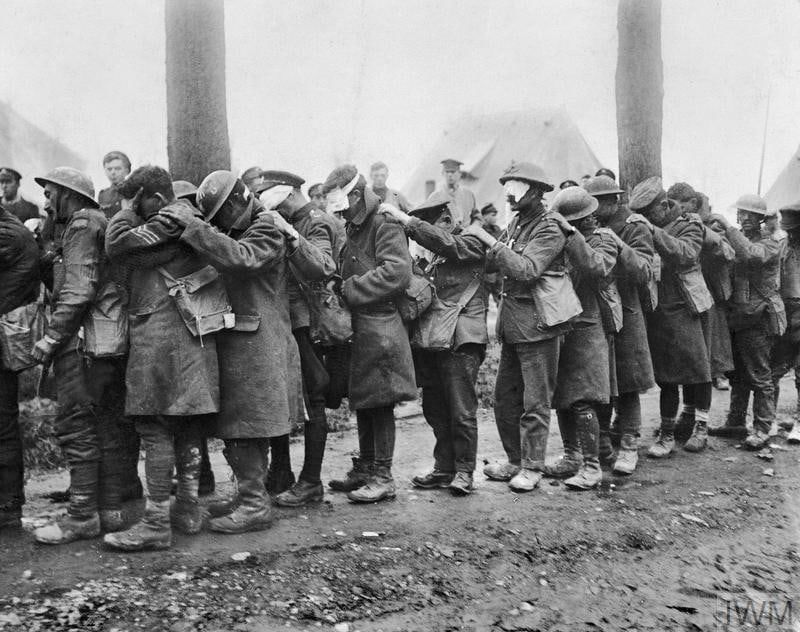
Ironically, at first, most German commanders were reluctant to use poison gas, regarding it as dishonourable and unchivalrous. Nevertheless, on the 22nd of April 1915, around 5pm, the Germans launched their first chlorine gas attack on the Western Front, sending clouds of yellow-green vapour rolling over French, Algerian, Canadian and British troops, entrenched along a four-mile front in the Ypres salient. The result was devastating as men were rapidly overcome, choking, spitting blood, rolling on the ground in agony, unable to breathe as their lungs flooded. The Allied press railed indignantly against German barbarism.
Diana Preston
And the German word was often deployed, Schrecklichkeit, frightfulness. There was a debate about this. The words debased warfare were used in the discussion.
Michael Baker
Barely a week after the first German chlorine attack, Haber's wife Clara shot herself, in protest it seems. It did not deter him, and the Germans stoutly defended their actions by claiming that the Hague Conventions said nothing about clouds of gas, as opposed to gas projectiles. Despite all their public protests, privately, the point was not lost on the British cabinet, who resolved to retaliate. It was not long before both sides had invented gas mortars, then high-explosive gas shells. A red line had been crossed, and a Pandora's box thrown wide open.
Diana Preston
First used by the Germans of chlorine gas in April 1915. By September of the same year, you have the British trying out chlorine gas in northern France. It became a kind of catch-up, I suppose. Fritz Haber and his team in Germany looking for ever more effective types of gas. The next one they came up with, the next major gas, was phosgene, which we have the Germans deploying at the end of 1915. But by February 16, we have the Allies ready to respond with their own version of phosgene gas. The next major gas developed was mustard gas. You find Germany using that in 1917, a gas with devastating effects, causing blistering on the skin, horrible side effects, fatal to many. The Allies ready to use mustard gas by 1918. But, of course, those are the three types of gas that we all know about. As this race accelerated, over 60 different types of gas were actually tested during the First World War. And all of this, of course, under the conventions which everybody had signed up to, was entirely illegal.
Michael Baker
Just over two weeks after the first use of poison gas, another red line was crossed. On May 7, 1915, off the coast of Southern Ireland, a German U-boat fired a torpedo which struck the passenger liner Lusitania, bound for Liverpool from New York. Within 18 minutes, the huge vessel sank, with the loss of 785 passengers and 413 crew.
Diana Preston
The rules governing maritime warfare go back to the 16th century, and they hadn't changed since then. They'd been endorsed at the Hague Conventions, hadn't been altered. And basically those rules, referred to as cruiser rules, said that you could not attack a merchant vessel without warning. If you suspected a merchant vessel of carrying contraband, the rules said that you must stop and challenge that vessel. You must go on board, inspect what was in the hold. If you found contraband, you then had the right to seize the ship and what was on board, possibly to destroy the ship, but not before you had given anybody on board the chance to get over the side into boats and to safety. What you could certainly not do under the rules, which is what happened in 1915, was without warning to attack a passenger liner.
Michael Baker
The context here was Britain's naval blockade of German ports, which effectively prevented German merchant vessels from putting to sea at all. The Germans claimed the blockade was illegal. They were quite aware that attacking merchant shipping through unrestricted submarine warfare contravened the Hague Conventions, but in German military circles, it was seen just like poison gas as a legitimate way of gaining the advantage.
Diana Preston
And of course the Lusitania, an iconic example, of that merchant shipping, still making the transatlantic run between New York and her home port of Liverpool. And when you look at the log books of U-boat commanders at that time, you see that not only the commander of the U-boat, which actually attacked the Lusitania, but other commanders on other U-boats, they were all looking for the Lusitania that spring. It was one particular submarine that happened to get lucky. But in the eyes of the German high command, she was regarded as a desirable and legitimate target. By showing she could be attacked, it was a way of making a statement, of showing that the campaign of unrestricted submarine warfare was something which the German military really meant to have an effect.
Michael Baker
And effect it had. The Lusitania's sinking drew worldwide condemnation. British headlines referred to the Huns' most ghastly crime, and riots broke out across the country, targeting German homes and businesses. The French press declared that the Germans' divorce from civilisation was now complete. In America, which had lost 128 of its citizens on the doomed liner, the response was equally hostile, with the Boston Globe calling the sinking the worst crime against humanity that the modern world has known.
Diana Preston
When the Lusitania was attacked, there was a huge outcry worldwide. Most neutral countries, including, of course, the United States, condemned the attack. So you found a German high command, the German military, starting to make excuses about why the Lusitania had been attacked, claiming she had not been what she appeared to be in simply a civilian ship. But also, we find there was a period when Germany stepped back from the campaign of unrestricted submarine warfare. Of course, you have to remember these decisions, very often taken at the very top, by no lesser person than the Kaiser.
Michael Baker
Whatever the German military's view, or the triumphalist tone of the German press in reporting the sinking of the Lusitania, the Kaiser himself waxed hot and cold about attacks on merchant shipping, fearful that it could turn the United States, in particular, against Germany.
Diana Preston
The Kaiser was concerned about it. I think so was the German civil government, particularly Chancellor Bethmann Hollweg. If you read the papers in the German archives, you can see a very bitter, at times very fraught, exchange between him as Chancellor and people in the German military, with him saying, you know, we must be very careful, we must step back from this, you don't understand the political implications of what you're doing. But as you say, the consciousness of the tightening stranglehold of the blockade that the Allies were imposing, that was a factor in the thinking. So you have a period where unrestricted submarine warfare continued, you have more ships being attacked, more civilian lives lost, stopped for a while, then you have it resuming, and when it did resume with the loss of further ships, and in particular some American lives, that proved perhaps the final straw for President Wilson in the United States was one of the reasons why in 1917 the United States came into the war.
Michael Baker
On May 10, 1915, the day of the first mass burials of Lusitania victims in the southern Irish port of Queenstown, a German zeppelin dropped incendiary bombs on Southend. The town was bombed a second time on May 26. The two raids killed four civilians in all and injured five others. These were, in fact, merely trials in preparation for a much bigger raid on London.
Diana Preston
First time the technology had got to the stage where you could get as far as London, but also what had happened in the background, of course, we always have to remember there was the Kaiser. Kaiser was quite fond of London and he had ambivalent feelings towards his British relations, some of whom resided there, but it took the German high command quite a time to persuade the Kaiser to actually permit the bombing of the British capital. So when it did happen, that was quite a significant step change.
Michael Baker
On the night of May 31st, 1915, Zeppelin LZ-38 released 91 incendiaries and 28 explosive bombs over London, mostly on the East End. Seven civilians were killed, four of them children, and 35 injured. These first air raids, always at night, brutally exposed the vulnerability of civilian populations to aerial bombing.
Diana Preston
You can imagine the effect on the London population of that night when this sort of silvery cigar-shaped thing was seen floating over the city, starting indiscriminately to drop high-incendiary bombs on the populace below. And from that time on, you have people very uncertain that death could drop suddenly from the skies anywhere, at any time. As we were discussing with the impact of gas on the battlefield to demoralise the enemy soldier, aerial bombardment of the civilian population again seen as something important psychologically, something to demoralise.
Michael Baker
There was widespread outrage that the Germans had used weapons of aggression against defenceless civilians. To prevent panic and divert attention from the country's lack of effective defences, the British government downplayed the raid on London, even censoring reports in the press. The Germans tried to claim they had bombed the London docks in reprisal for a French air raid on the town of Ludwigshafen. In fact, the French had targeted a munitions factory which produced poison gas. From here on, Zeppelin raids on London and other British cities became more common, with scores of civilians killed and hundreds injured. In response, British air defences improved and German airships were soon shot down. By 1917, both sides were using long-range bomber aircraft over enemy cities, with civilians in London, for example, sleeping overnight in cellars and underground stations in scenes much more reminiscent of the Second World War.
Diana Preston
It's interesting, if you compare what happened with poison gas, where you very quickly see like following like, Germany developed a particular type of gas as fast as they could, so did the Allies. If you look at what happened in terms of aerial bombardment, it was not really like that, but I think what you did see was less anxiety, less discrimination in the choice of targets, that if there were to be collateral damage, if you were bombing, say, an armaments factory or somewhere strategic, if civilians should suffer as well, well, so be it. That was only fair because, after all, look what was happening to your own population. So if you like, you see the beginning of a, can you call it, quite a moral decline, a moral descent, but not to quite the same extent as in gas.
Michael Baker
Given that aerial bombardment of civilians, along with the use of poison gas and indiscriminate sinking of merchant vessels, were all illegal under the Hague Conventions, I wondered whether, at the end of the war, the victorious Allies had attempted to bring their enemies to book.
Diana Preston
Yes, that's a very interesting question because there was a huge appetite, certainly amongst the British public, for it to be seen to be some sort of retribution. And of course, the popular slogan, hang the Kaiser, and even the King saying that he regarded his cousin as one of the greatest war criminals who had ever existed. When the Allies got together at the Versailles Conference, they discussed the question of war crimes. And it was agreed then that if the Kaiser could be extradited from Holland, because by this time he had gone into exile in Amerongen, if the Dutch were prepared to countenance his extradition, he should go on trial. And it was also agreed that people against whom there were serious charges of war crimes should be tried at military courts. But the reality was that nothing very much happened. The Kaiser, of course, was never extradited from Holland, even though, quite interestingly, in the last stages of the war, he himself was very concerned that he would be tried for war crimes charges, and was particularly concerned that the sinking of the Lusitania would be one of the crimes brought against him. In terms of the wider range of people who could have found themselves coming to trial, in the end, it was really relatively small numbers, and they didn't appear before military courts at all. Some people were tried before a court in Leipzig, but on the whole, the sentences were very light, very lenient. You do come up against this question of whether if you're ordered to do something, then that makes you innocent. You know, the defence of I was only obeying orders, and we have an example of some German submariners who fired on Allied soldiers floundering in the water. They were brought to trial, and they claimed that they were following the orders of their superior officers, but that was deemed not morally or legally to be an acceptable justification, so they were convicted of that crime, but again, we see what occurred in other places that the sentence was relatively light, and in any case, not long after they escaped. I think in the difficulties of the whole post-war settlement, the whole thing really rather went away. There were views, certainly in some circles, that, of course, if you were seen to be too harsh in bringing charges, what might that mean for your own people in future circumstances, where they might find themselves, if they were on the losing side, being charged with similar things, but of course, I think the failure to properly prosecute war criminals at the end of war, difficult as it would have been, did have consequences that didn't go unnoticed. After all, as you move into the interwar years, you have Hitler making remarks about the Armenian genocide, saying, well, who remembers the Armenians now? Nobody was brought to book for that, and certainly, the coroner who presided over one of the official hearings into the loss of the Lusitania, he was very bitter about the fact that no one was ever brought to book for the sinking of the Lusitania. He thought it was a very bad precedent, and in later years thought it would have repercussions for future war crimes that people would feel that they could act with impunity.
Michael Baker
After the war, the pre-1914 legal position on poison gas, attacks on merchant shipping, and the bombing of civilians was reiterated at successive international conferences. However, by the 1930s, all these rulings were being challenged. The Italians used mustard gas in Abyssinia, the Japanese employed gas and civilian bombing in Manchuria, and notoriously, in 1937, the Axis powers laid waste to the Spanish town of Guernica. It's also worth mentioning, as an ironic footnote, that in 1919, the chemist Fritz Haber, Jewish by birth, had fled to Switzerland in disguise, fearful that the Allies would try him as a war criminal. His colleagues back in Germany, meanwhile, went on to develop a new gas, Zyklon B, useful as an insecticide, but later, the principal killing agent used in the Nazi death camps.
Diana Preston
If you look back through the centuries, people have always applied science to warfare where they've been able to do that, and of course, as you've become more technologically advanced, the more opportunities. What I felt in writing A Higher Form of Killing was that what we saw in those six weeks, that narrow window in 1915, was a two-step change of very rapid acceleration, where different types of technology were all being employed to the end of killing ever larger numbers of people ever more remotely, you're starting to see a real disconnect between the perpetrator, the person who fires the weapon, and the effect. After all, if you're miles up in the sky in a Zeppelin, as some of the Zeppelin commanders observed, and you're dropping bombs, you're very unaware of what's happening on the ground. If you're releasing gas from canisters in the direction of enemy troops, where you're a mile or two behind where those troops are, you're not actually seeing the effects of it. If you're a submarine commander ordering a submarine torpedo to be fired, you've probably submerged and sailed away by the time the ship is sinking and people are drowning in the water. You're not seeing the effects of what's going on. I think also what happened during those six weeks were something we're very familiar with, sadly, in our own time. You're starting to see civilians becoming regarded as legitimate targets in warfare, despite the fact that, of course, such a thing completely illegal then, as indeed it still is today.
Michael Baker
I asked Diana finally whether she thought that in each instance it was the Germans who had crossed these red lines first.
Diana Preston
I think if you look at the sequence of events in 1915, which is the focus of my book, but also later on through the war, I think that that is actually the case. And you can also trace it back to the very outbreak of the war, where you find Germany invading through Belgium without warning in contravention of what had been agreed at the Hague conferences, and you have the German Chancellor, Bethmann Hollweg, getting to his feet in the Reichstag and saying to his comrades that he admitted quite openly that Germany had committed an illegal act, but this was the act that he hoped would enable them to win the war swiftly and was therefore justified. On each occasion, I think it's true to say that Germany did take the first step.
Michael Baker
I've been talking with the author and historian Diana Preston about her book, A Higher Form of Killing, Six Weeks in World War I That Forever Changed the Nature of Warfare. If you want to know more about Diana's work, please follow the links on my website, www.unknownwarriorspod.co.uk. In the next episode of Unknown Warriors, I'll be looking at an unfamiliar aspect of the Battle of the Somme, at how the new phenomenon of shell shock reached crisis levels and what the British Army did about it. I hope you'll rejoin me.
Music: Satie’s Je Te Veux
Michael Baker’s narration in italics. This transcript was made automatically from the audio and may contain errors.