The question
Did the First World War really end in 1918?
We think of the First World War as 1914–18, but Professor Robert Gerwarth explains that 1918 did not end the fighting in much of Europe: violence continued well into the 1920s as new nation-states emerged from collapsed empires.
Key takeaways
- 01For much of Europe, 1918 did not end the war.
- 02Violence continued well into the 1920s.
- 03New nation-states emerged out of the chaos of collapsed empires.
From the transcript
If you look at the defeated states of the First World War, all the way from Germany to the Ottoman Empire, from Russia and the lands between, the 11th of November 1918 is a date without meaning, because violence continues often in even more brutal forms and ways well after 1918.
But at the risk of simplification, we can say that at least 4 million people … die as a result of violent conflicts of one kind or another between 1918 and 1923, which is quite an astonishing figure because it's more than the added wartime casualties of Britain, France, and the United States between 1914 and 1918.
As a member of the German Freikorps later recalled, We laughed when they told us the war was over because we were the war.
So if, say, you're a Bolshevik, then your enemy is a class, right? … there's no way, as a middle-class Russian, that you can surrender. Because the whole idea is that you vanish, you disappear, that your entire class disappears.
Full transcript
Read the full transcript
Music: Erik Satie’s Je Te Veux (piano/vocal)
Michael Baker
Welcome back to Unknown Warriors with me, Michael Baker. We're used to seeing the First World War as a well-defined period between precise dates, 1914 and 1918. And in a sense, the centenary commemorations reinforce this notion of a self-contained conflict that somehow existed in a historical vacuum. The growth in recent years of comparative history and transnational studies has made it impossible to sustain this view. Professional historians are now increasingly making the case for the connectedness of the war to events both before 1914 and after 1918, with profound implications for the place of the conflict in the wider history of the 20th century. A striking example of this new perspective can be found in a book that came out in 2016 called The Vanquished, Why the First World War Failed to End 1917-23. I spoke with its author, Robert Gerwarth, Professor of Modern History at University College Dublin. I asked first, how did he justify the title of his book?
Robert Gerwarth
Well, essentially, the conventional chronology of 1914 to 1918 makes a lot of sense for Britain and France, but not so much for most of the other combatant states of the First World War. So if you think of the United States, they only enter the conflict in 1917, the year that Russia effectively leaves the coalition against the central powers. If you look at the defeated states of the First World War, all the way from Germany to the Ottoman Empire, from Russia and the lands between, the 11th of November 1918 is a date without meaning, because violence continues often in even more brutal forms and ways well after 1918, all the way to 1923 with the end of the Russian Civil War, but also with the conclusion of the Treaty of Lausanne with the Ottoman Empire slash the Republic of Turkey, which essentially turns Turkey from a defeated state of the First World War into a victor state and consolidates the territory in Anatolia.
Michael Baker
So in Central Europe and eastwards, 1918 did not see the end of conflict, far from it. What form then did this renewed violence take?
Robert Gerwarth
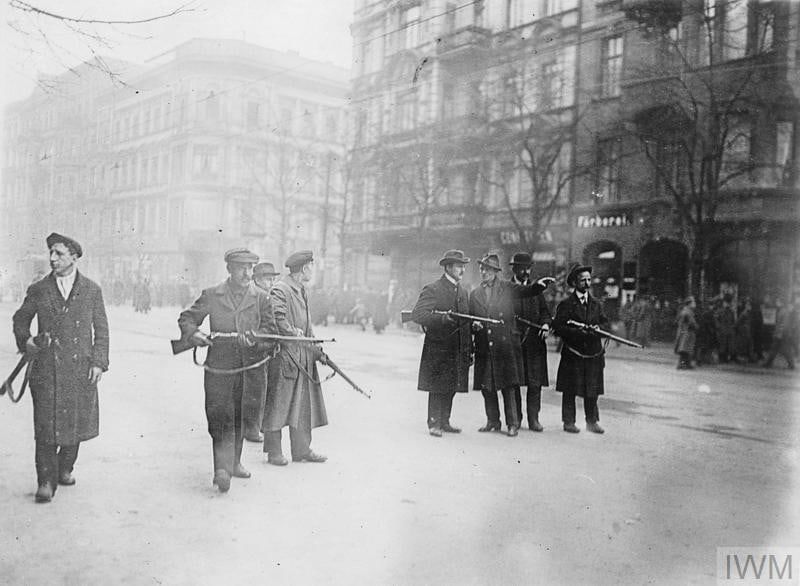
What is characteristic about the violence that we see is that it's extremely messy, so it's difficult to compartmentalise the kinds of violence that we see. But at the risk of simplification, we can say that at least 4 million people, that's a very conservative estimate, die as a result of violent conflicts of one kind or another between 1918 and 1923, which is quite an astonishing figure because it's more than the added wartime casualties of Britain, France, and the United States between 1914 and 1918. So these people die of different kinds of violence from interstate conflicts, for example, the Soviet-Polish war, which kills about 250,000 people, or the conflict between Greece and Ataturk's Turkish nationalists in Anatolia, which also kills roughly 250,000 people. In addition to that, you have revolutions. There are roughly 30 revolutions between 1918 and 1920 across Europe, so violent regime changes, which then in turn prompt violent responses from those who don't want a revolution. So you have revolutionary and counter-revolutionary violence, which in certain places turns into civil wars. Russia is one example, but another often forgotten example is Finland, which is a really interesting case. It's actually proportionate to size, one of the most violent civil wars of the 20th century, where within less than three months, 1% of the overall population perishes. And then you look at places like Germany, where certainly in towns like Munich, for example, in 1919 or Berlin in the spring of 1919, you can talk about civil war. I mean, Berlin in March 1919 is bombed from the air. There's heavy artillery. More than 1,000 people die that month in fighting between communists on the one hand and government soldiers on the other. And at the same time in Italy, you have an almost revolutionary situation in which left-wing groups and nascent fascist groups fight on the streets, in which you have sort of land grabbing and factory occupations. So there are pockets of civil war across Europe. And all of that during a period which we often think of as the interwar period. And of course, in the French Empire, there's also colonial unrest. And if you look at the British case, which is interesting, you can't really talk about a peace period either, because it is, of course, during this period that Ireland becomes independent. If you look at the sheer size of that territorial loss, view it in relation to Britain's overall size, then Britain actually loses more territory in the aftermath of the First World War than Germany as a result of the Treaty of Versailles. So to what extent this can be seen as a peace period is open for debate.
Michael Baker
This continuing violence after 1918 can only be understood by looking at the way in which the war changed during its course and ended up in a very different place from where it had begun.
Robert Gerwarth
I think that the final year of the war is a really interesting and crucial one, because the already unimaginably brutal war is turning into something else, a more existential conflict, if you like. What I mean by that is that initially the war is quite similar to 19th century conflicts, in the sense that the Germans want to grab more land, and it's about preventing Germany from becoming the hegemon on the European continent. So these are sort of quite conventional war aims, if you like. And they escalate increasingly. And from 1917 onwards, with the Bolshevik Revolution, you also have this injection of ideology, not just in Russia, but actually across the European continent and further afield. So to a certain extent, the Russian Revolution mobilizes those who are in favor of dramatic socioeconomic change everywhere in the world, but also those who want to prevent it at any cost, even if a Bolshevik Revolution is not really on the cards. Say, for example, in Germany, the supporters of a Bolshevik Revolution are quite marginalized, and it's never really a possibility because the strongest working class movement, the SPD, is very staunchly against the Bolsheviks. But even here, the right is mobilized through the fear of a Bolshevik revolution potentially happening in Germany. And the same in Britain and France. There are very sizable movements that can be classified as anti-Bolshevik. What is also important is that there are different kinds of revolutions happening at the end of the First World War. There are political revolutions, which are already referred to, but there are also national revolutions. So up until 1918, Europe is a continent that is dominated by empires, by land empires, and by overseas empires or blue water empires, Britain and France in particular. And in 1918, with the defeat of the central powers, that radically changes. It's probably the most radical reshuffling of Europe's borders in the modern period, what is happening. So you have an implosion of these land empires, vast centuries-old land empires, and instead the emergence of nation-states that aren't really ethnically homogenous nation-states. They are as ethnically diverse as their predecessors, but they view themselves as nation-states, from Poland to the Baltic states to Czechoslovakia, Yugoslavia, you name it. So it's a radical reshuffling of the borders of Europe, but these borders are contested by the very sizable minorities that suddenly emerge. So, say for example, in Czechoslovakia, you have three million ethnic Germans living in the Sudetenland, whose existence is not even reflected in the name, even though there are more ethnic Germans in Czechoslovakia than Slovaks. And they feel marginalised within that state. And of course, the quest to be reunified with their respective homelands becomes one of the burning issues throughout the interwar period, all the way to the Second World War.
Michael Baker
After 1919, 13 million Germans found themselves living outside the Reich. Over 3 million ethnic Hungarians lived in other states. 35% of Poland's inhabitants were non-Polish. And as nationalist governments began to ignore or discriminate against these large and vocal minorities, this was a recipe for discontent and unrest. Replacing the defeated European empires by nation-states, the imposed solution of the 1919 Paris peace settlement, arose out of American President Woodrow Wilson's insistence that the new world order should be grounded in the principle of national self-determination. Given the clout of the wealthy United States, at the end of such a cripplingly expensive war, it had seemed a good idea at the time.
Robert Gerwarth
The principle of national self-determination is a very idealistic one. And in theory, it sounds great, but very often the reality looks quite different. Because applying the principle of national self-determination to a space as diverse as East Central Europe will automatically mean that once you give a particular ethnic group the right to national self-determination, another one will be offended by the same principle. So you're probably creating more problems than you solve. I'm not suggesting that the Habsburg Empire was a perfect state, but it is an evolving state in which many minorities actually manage to accommodate themselves. And just to give you one concrete example, the Jews of the Habsburg Empire. So the Jews of the Habsburg Empire are actually the strongest supporters of the imperial idea because they are concerned, quite rightly, as it turns out in the 1930s and 40s, they are very much concerned that in a state which wants to be ethnically homogenous, they will be the ones that will be outcast from the rest of society. Whereas in the Habsburg Empire, they have full legal equality. They are recognized as citizens of the Habsburg state. And so if you read the great nostalgic novels about the Habsburg Empire that are written in the interwar period, Stefan Zweig, of course, you realize that they're all written by Habsburg Jews. It is not a coincidence because the reality of the ethnically exclusive nation states post-1918 does in fact, as they suspected, mean that the Jews are considered outsiders in these societies in a way that they weren't prior to 1918.
Michael Baker
There's a long-running debate among historians about what explains the levels of violence seen in the interwar years. The more traditional view has argued that broadly the world had been brutalized by the scale and horrors of the first ever global conflict. But this thesis doesn't hold for those combatant nations, Britain, France, the United States, that were largely peaceful after 1918. So what's really going on here?
Robert Gerwarth
The reality is that the world is, of course, a more brutal place post-1918 than it had been prior to 1914, when Europe had actually enjoyed a remarkably long period of peace and globalization. But the question is, what brutalizes people? And that's a long debate in the historical literature. Is it, as some people have suggested, the war experience itself that is turning combatants into brutalized monsters that are much more open to radical ideologies such as Bolshevism or Fascism or National Socialism? Or is the brutalization coming from somewhere else? And it is a very complicated story. In Germany, you've got the Freikorps. In Ireland, you've got the Black and Tans. And these are all, in the majority, participants of the First World War, men who clearly like what they are doing and who want to continue their existence as soldiers into the post-war period. But these are very small minorities. I mean, if you look at the numbers, even the most generous estimate would probably be that there are roughly 100,000 men that can be associated with the German Freikorps. But that's out of 6 million German soldiers. And the vast majority of them actually go home and they want nothing to do with war anymore because they have suffered the consequences of it for four years. And it's the same in other countries as well. The dominant veterans' organizations are much more concerned with issues such as pensions, widows' pensions, compensation for, you know, limbs that they lost during the war than they are with starting a new war. So the people who are driving that agenda tend to be people of a younger generation, the so-called war youth generation, which is quite important in the rise of national socialism in Germany. So these would be kids who are adolescents during the war, just too young to fight, and who in 1918 firmly believed that if they had been given an opportunity to fight, the outcome of the war would have been a different one. The war experience itself is not fundamentally different for German soldiers, French soldiers, British soldiers, but it is in Germany that the Nazi party eventually triumphs in 1933, whereas in Britain and France there's no similarly strong fascist movement or communist movement. So there must be other factors at play as well. One factor certainly is defeat. It makes a huge difference whether you end on the winning side or the losing side. So I'm pretty sure that if, say, Britain had lost the First World War, there would have been a tidal wave of radicalization as well against the political system, which in the eyes of many would have lost its legitimacy because it supported a war that didn't go as planned. So I think victory or defeat makes a big difference in terms of future political trajectories. Then there's also, of course, the imperial dimension, which we already talked about. So if empires implode, then there is a great chance that people, particularly if they live in embattled borderlands, have a much stronger sense of an ongoing conflict than if you're living in a metropolis. So what I'm trying to say is it makes a huge difference whether you live in Berlin during the 1920s or whether you live in Upper Silesia, which is contested by Poland and Germany. So it's not a coincidence that many of the leaders of the Nazi movement come from these embattled borderlands. For them, ethnic conflict is a lived reality. They see that as part and parcel of their political experience.
Michael Baker
A common experience of officers coming back from the war to both Germany and Austria-Hungary was to have their epaulets torn off by jeering left-wingers. So it's not difficult to see how men who felt shamed by defeat on the battlefield and robbed by the peace of their homeland as they saw it could easily become radicalised and join paramilitary groups. As a member of the German Freikorps later recalled, We laughed when they told us the war was over because we were the war.
Robert Gerwarth
The space for paramilitaries is created by the collapse of states and with the collapse of states also the collapse of national armies. This is particularly the case, of course, in Russia where the Tsarist army no longer exists and instead you have different armed groups which claim to be the legitimate heir to that army. But it's a contested claim. So in Russia, for example, you've got the Red Army and the White Armies fighting out who might be the legitimate heir to the Tsarist empire and the Tsarist army. And in Germany, for example, the very significant reduction of the army as a result of the Versailles Treaty leaves a space for armed groups outside of the regular army. And these are interesting groups because they're not only composed of veterans of the First World War. The more radical element, perhaps, are the members of that war youth generation. So cadets, nationalist students who want to compensate for their lack of combat experience. And these groups form very dynamic armed units in which self-radicalization plays a very important role. And also, of course, these groups don't find themselves bound to the rules of law. That's what makes the violence of the post-war period so much more gruesome in some ways. The First World War, despite the huge numbers of civilian casualties, is a conflict that is primarily fought between combatants. Whereas in post-war Europe, the targeting of civilians becomes acceptable. And that's because the violence that we encounter here is underpinned by a different logic. So if, say, you're a Bolshevik, then your enemy is a class, right? It's class warfare. And unlike in the First World War, where the aim is to force your opponent to accept certain conditions of peace, there's no way, as a middle-class Russian, that you can surrender. Because the whole idea is that you vanish, you disappear, that your entire class disappears. And the same, if you look at the logic of violence of the Nazis, for example, if you're Jewish, you cannot escape your Jewishness, you cannot surrender, and then you will be treated as a prisoner of war. The idea is that your entire race disappears. So there's a totalizing logic of violence which shows its full impact during the Second World War. But the logic is kind of born in those early post-war years.
Michael Baker
We've already heard how the Bolshevik Revolution of 1917 triggered a virulent ideological struggle across Europe between those who sympathized with Bolshevism and those who hated it. Caught in the crossfire was one group which was to suffer more than most from the extreme ethnic violence of the 20th century, the Jews.
Robert Gerwarth
This connection between, or alleged connection between Jewishness and Bolshevism is a crucial one because it becomes one of the main drivers behind anti-Semitic violence which we first encounter during the Russian Civil War when particularly, but not exclusively, the white armies sort of descend on the Jews who they accuse of being supporters of Bolshevism. Now, of course, Jews are over-represented in the Bolshevik movement for obvious reasons because Lenin and the Bolsheviks claim rightly or wrongly that they are colorblind when it comes to religion or ethnic background. They are simply interested in class. So it is viewed as a liberation movement and the Jews of the Tsarist Empire had a much more difficult experience prior to 1914 than, say, for example, the Jews of the Habsburg Empire. But this association becomes a very powerful tool because it suggests that Jews are actively involved in conspiracies against the Western way of life. So Bolshevism is perceived and portrayed in Western Europe as something Asiatic and also something that is driven by non-Christians. So it is perceived as something entirely alien to European culture. And this is a very powerful story which travels throughout Europe, of course, then also into the United States. It is reinforced by the worldwide publication of various conspiracy theories, the protocols of the elders of Zion, for example, which becomes an international bestseller. So the perception of Jews as the kind of wire-pullers behind, perhaps paradoxically, behind both Bolshevism on the one hand but also behind capitalism on the other becomes sort of a very powerful narrative of the right in the interwar period.
Michael Baker
One of the key losers of the First World War was the Ottoman Empire. 800,000 of its soldiers had died with civilian casualties of some 2.5 million. This vast empire straddling the Balkans and the Middle East was essentially divided up between Britain, France, Italy and Greece. And yet, in defiance of the Paris peace settlement and in a process driven by a war with Greece and extreme ethnic violence, there emerged in the early 1920s a secular Turkish state led by the formidable Mustafa Kemal, known as Ataturk.
Robert Gerwarth
Ataturk plays a huge role in the sort of imagination of various revisionist leaders in the interwar period for a number of reasons. I mean, first of all, because of his willingness to stand up to the Allies, with force if necessary, to revise the peace treaty of Sèvres, which is the first treaty with the Ottoman Empire, that essentially leaves the Turks with a totally disintegrated state. They don't even have control over all of Anatolia, which they consider to be the core lands of the Turks. Instead, the Greeks get some territory, so do the Italians. There is allied control over the Ottoman finances, etc., etc. So defiance plays a huge role in why Mussolini and Hitler view Ataturk as their mentor, their spiritual mentor. So Ataturk is willing to go to war to fight for a new peace treaty, which he gets in 1923, after successfully defeating the Greek invasion army. Hitler is very impressed by that because, from his point of view, the German government is basically giving in to any Allied demand. And then throughout the 1930s, from 1933 to 1939, he's busy undoing the international order, which is based on the Paris peace treaties.
Michael Baker
So to pull together some of these threads, when we look at the more familiar violence of the 1930s, in Nazi Germany in particular, but elsewhere as well, it's strikingly foreshadowed by the violence of the immediate post-war years, with its paramilitaries, its violent border conflicts, its bitter street fighting between left and right, its racialised rhetoric, and its blurring of the boundaries between civilians and non-civilians.
Robert Gerwarth
The political agenda of the Second World War is very much set in the aftermath of the First World War. Radical violence against both combatants and non-combatants. That logic is also born in the immediate aftermath of the First World War. It's kind of reactivated on a much bigger scale once the Great Depression hits. The reason why people vote for Hitler is not because they want a genocide, it's because they believe Hitler, who at this point tones down his rhetoric on anti-Semitism, to restore Germany's greatness prior to the First World War. Nonetheless, of course, the Nazis are, and always were, a political movement that was fundamentally wedded to the idea of resolving what they consider to be the major issues of Germany through violence, if necessary. So even if Hitler tones down the rhetoric, the nature of the movement doesn't change. And you can see it then unfolding from the later 1930s onwards. And the same actually is true for other ultra-right-wing or ultra-left-wing movements across Europe. These were born in the aftermath of the First World War. They gain strength in a massive way post-1929. I mean, Germany's not the only democracy that vanishes in 1933. In fact, all of the democracies that were created in 1918, with the exception of Finland and Czechoslovakia, are gone by 1933. They've all given way to totalitarian regimes of one kind or another. So there's an authoritarian moment in European history triggered in part by the Great Depression, where suddenly Britain and France are the only remaining major democracies in Europe. So the situation changes dramatically between 1918 and 1933. And these ideological agendas, but also the practices of violence that come into existence during and after the First World War, are then basically reactivated during the Second. And notably, you see that line of continuity, of course, on the Eastern Front, where, after 1941, the targeting of civilians is no longer a byproduct of war. It is deliberate, and it's part and parcel of what the Nazis are trying to achieve, because they view the ethnic makeup of Europe as something that is hierarchically structured, and in which certain races have the right to not just rule over others, but also to decide who lives and who doesn't. And I think that this logic already can be traced to the immediate aftermath of the First World War.
Michael Baker
I was talking to Professor Robert Gerwarth about his book The Vanquished, Why the First World War Failed to End, 1917-23. If you want to know more about Robert's work or the aftermath of the First World War, please follow the links on my website, www.unknownwarriorspod.co.uk. In the next penultimate episode of Unknown Warriors, I shall be examining a recent general history of the First World War which attempts unusually and boldly to analyse the whole conflict within a unified and coherent interpretation. I hope you'll rejoin me.
Music: Satie’s Je Te Veux
Michael Baker’s narration in italics. This transcript was made automatically from the audio and may contain errors.