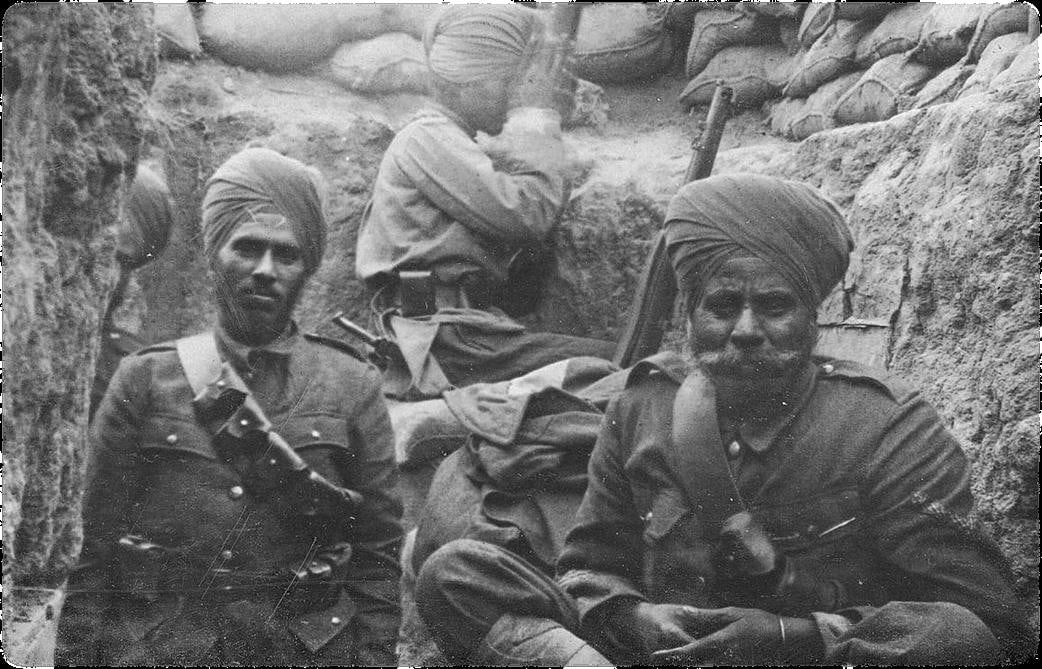
Welche Rolle spielten indische Soldaten im Ersten Weltkrieg?
1,5 Millionen Inder meldeten sich im Ersten Weltkrieg freiwillig, um für Großbritannien zu kämpfen. George Morton-Jack zeigt, wie ihre Geschichte allzu oft ignoriert oder missverstanden wurde und warum sie für die Verteidigung des britischen Empire entscheidend waren.
Das Wichtigste in Kürze
- 011,5 Millionen Inder meldeten sich freiwillig, um für Großbritannien zu kämpfen.
- 02Ihre Geschichte wurde allzu oft ignoriert oder missverstanden.
- 03Für Großbritannien ging es im Krieg auch um die Verteidigung seines Empire, und indische Truppen waren dafür entscheidend.
Aus dem Transkript
One big point showing the significance of the Indians is that in autumn 1914, they formed a third of all the British forces in France. And as my book shows, they saved the British from defeat on the Western Front.
The problem with that, and why it's a myth, is that it's based on racism. It's based on the idea that Indians, because they're not white, were weaker and therefore less able to endure the Western Front. … They were just as human as anyone else.
What the cameras didn't show at the time is that behind them, behind the photographers, were walls or fences with barbed wire, meaning that the Indian soldiers weren't allowed to leave and there were British soldiers acting as sentries at the gates of the hospital.
On one hand the British tried to isolate them censoring their letters … but that misses the point that the Indian soldiers always wanted freedom themselves anyway and there was nothing the British could do about that.
Vollständiges Transkript (auf Englisch)
Das vollständige Transkript lesen
Musik: Erik Satie’s Je Te Veux (piano/vocal)
Michael Baker
Welcome back to Unknown Warriors with me, Michael Baker. Whereas previously we've tended to view the First World War through a narrow national perspective, Britain's role or France's or Germany's, in more recent years professional historians have begun to turn their attention to the global nature of the conflict. This was, after all, a struggle between competing worldwide empires, so it's not surprising that theatres of war outside Europe, on other continents such as Asia and Africa, should now be the subject of study and research. But there was, in fact, one army that had enormous experience of fighting across the globe long before the First World War, and which then came to play an invaluable role when that war broke out, serving in some 50 different countries. This was the British Indian Army, the traditional policemen of Britain's far-flung empire, which in the course of the First World War would contribute one and a half million volunteers to the Allied cause. And yet it's extraordinary how the Indian contribution has, until very recently, largely been left out of the narrative. I spoke to George Morton Jack, whose book, The Indian Empire at War, came out in 2018. I wondered first why the Indian story in World War I had been so overlooked.
George Morton-Jack
Fundamentally, there's a divide between the Indian and the European participants, in that there were many more illiterate Indian soldiers compared to British or white troops. And of course, as we know from Wilfred Owen and many other familiar names, the white troops wrote down a lot about their experiences, both before and after the war. And many Indians also wrote down their experiences, but to a much lesser extent. And so there's this imbalance between illiterate and literate participants in what sources we have. And that also applies to participants from Africa and elsewhere. But also there's a problem with the Indian sources that are available, that originate from the time of the First World War. A lot of the sources that were generated were generated in Europe. So, for example, on the Western Front, there were many more cinema reels and photographs. than we find in other parts of the world at the time, so in Africa or Asia. And today, there are problems which relate partly to archives in India and Pakistan, haven't gone through processes like we have in Europe, of harvesting archives people might have at home and putting them in archives or having a tradition of things being donated because they're seen as important to the nation. So I suspect that across homes in India and Pakistan, there are still going to be a lot of First World War sources, which are lying around, which people might not even know about. But another problem we have today is that a lot of the communities where we might find oral memories of the First World War in India and Pakistan, they might not be accessible. So, for example, in Waziristan, an area on the border of Pakistan and Afghanistan, there were communities who provided soldiers in the First World War. But that's become a very dangerous place to visit, and there's no way you could go there today and try and ask families about their histories. Whereas if one was to go to Cheshire and look for family stories, it would be safer.
Michael Baker
So, where it's existed at all, what broadly has been the traditional narrative about the Indian experience in the First World War?
George Morton-Jack
It's important to make a separation between what's been said by British historians and what's been said about Indian historians, because history often falls along the lines of national traditions and how people look at things from their own national points of view. And in Britain, as we know, there's been such a strong emphasis on the white experience of the war or the Tommy. And so that's meant that in many general histories of the First World War, even up to the early 2000s, often the Indian soldiers won't be mentioned. And I can think of examples of, say, BBC history of the First World War that talked about the whole war without bringing in the Indians. And so we've had a tradition of either just not talking about the Indians, or they have been included, but they've been criticised, and Arthur Conan Doyle was one of the first authors to do that. The criticisms being that the Indian soldiers were inferior to white soldiers, and that created a tradition which also has lasted until quite recently. Another thing in the history is that there's been a tendency to treat them as if they served on the Western Front, and that was an important part of the World War. But if they served elsewhere, those theatres weren't so important and don't matter so much. And so that's fed into an idea that the Indian soldiers are somehow outside the main event, they're not so important, and they're a subject that can be justifiably neglected. So if you look at general histories of the First World War, back until the 1950s, often they'll have a short subsection at the back about a theatre that the Indians served in, East Africa, for example, and it will be half a page, whereas the rest of the book will be about the Western Front. On the Indian side, there's a very different thing going on with a tradition of Indian nationalism, and how do you fit in soldiers who served the British into histories that look back into what are the origins of independent India and what's its history. And often Indian historians would choose to emphasise the incompetence of British leadership, and on the other hand, discuss the revolutionary ideas that the Indian soldiers held, but without really inquiring into either side of the coin too much.
Michael Baker
Another traditional approach has focused on the bravery and loyalty of Indian soldiers, and their positive role in defending civilised values.
George Morton-Jack
And that's before the period I was just talking about, so that's the literature from the 1920s, 1930s and 40s. The empire is still going strong, and there was an underlying political need to present Indian soldiers as servants of the colonial state in a positive way, which involved concepts of loyalty, of bravery, and of fighting for the right.
Michael Baker
So how, more recently, is the picture now changing, and why?
George Morton-Jack
The seeds of it, in many ways, were sown in the early 2000s, when academics started to look at the First World War and see what might be unexplored about it. But then things really changed gear with the centenary recently. I think according to one survey, this has almost doubled the number of people in the UK who were aware that Indians participated in the First World War. But this change that's been going on has a number of tensions underneath. There's a sense that the Indian soldiers, according to how they've been portrayed in much of the centenary commemorations, were brave, fighting for democracy, alongside British troops. And that can seem to echo almost some of that literature from the 1920s and 1930s we were talking about. What was really going on is that the Indian soldiers were being interpreted for much of the centenary. As an example of togetherness 100 years ago, which should resonate with us again. The problem with that is that it's not dwelling on the problems of the colonial relationship, the realities of what's really going on underneath. I think as the recent remembrance of the Amritsar Massacre has shown us, there are great complications about Britain's historic relationship with India, and that applies to the First World War as much as anything else.
Michael Baker
The Amritsar Massacre of April 1919 occurred when a British officer, Brigadier General Reginald Dyer, ordered his Indian troops to fire on a large, unarmed and peaceful crowd, which had gathered without official permission for a political rally in a public garden. It was a Sikh holy day in the Punjab, and many families were present, including children. Estimates of the dead ranged from the hundreds up to a thousand, with many more wounded. Set against a backdrop of growing nationalist protests in India, the massacre served to underline the brutal reality of British colonial rule. At the time, many in Britain hailed Dyer as a hero who was unjustly vilified for doing his duty, but a committee of investigation later censured him, forcing him to retire from the Indian army.
George Morton-Jack
What my book tries to do is look at what the myths are and show how we can look at things differently. On the widest level, the most important thing that's been missed about the Indians and their participation in the war was the sheer significance of what they did and how central that was to what happened in the war and the course that the war took. One big point showing the significance of the Indians is that in autumn 1914, they formed a third of all the British forces in France. And as my book shows, they saved the British from defeat on the Western Front. There was a moment of a few days at the end of October 1914 and early November, without the Indians, then there would have been a British and an Allied defeat. That doesn't mean we should isolate that from all the other events. The British Expeditionary Force had already played its own part since September. The French army had made by far the biggest contribution to preventing a German victory. There was a moment when the Indians had critical importance, but that's within the context of everything else that happened in 1914. Another myth that has endured, what I mentioned earlier, was that somehow the Indian soldiers were weaker than the British. They were mentally and physically less able to fight and endure the Western Front. And as a result, they were removed from there at the end of 1915 before a second winter set in. The problem with that, and why it's a myth, is that it's based on racism. It's based on the idea that Indians, because they're not white, were weaker and therefore less able to endure the Western Front. What recent research has shown, and this is brought out in my book, is how Indians were effectively the same. They were just as human as anyone else. They had professional skills before 1914, and they were able to adapt after 1914, just the same as white troops.
Michael Baker
One striking fact testifies to this. When the Canadian Expeditionary Force arrived to fight for the Allies on the Western Front in October 1914, it was deemed necessary to give them six months' training in England first. By contrast, the Indian Expeditionary Force was considered experienced enough to go straight into the front line. Contrary to received wisdom, Indian troops had many of the skills essential for trench warfare on the Western Front.
George Morton-Jack
For many years, the Indian Army had been one of the most professional in the world. In mountain fighting, it was perhaps the best in the world, having had continuous experience of it for decades. And that meant that in 1914, in Egypt and also in France and Britain, Indian troops were recognised as being best prepared because of their training and able to fight immediately. The Western Front, as we know, was relatively static. But the Indians, for a long time, had been fighting on their own static front, which was the northwest frontier of the British Empire in India. And they had been fighting Muslim tribesmen there who were well-armed for a number of years before the First World War. And skills, including sniping, were very important there.
Michael Baker
Of the 80,000 Indian troops who fought on the Western Front in the First World War, all would have been trained in the most up-to-date weaponry and tactics. Up to 1914, Indian sepoys used the same manuals as the British Army itself. And their British officers were often ambitious to instil high standards of professionalism. On the Western Front, Indian soldiers would excel as German sniper hunters and trench raiders and proved resourceful at making improvised grenades. Moreover, their sickness rate over the terrible winter of 1914-15 was half that of the British Tommy. However, Indian soldiers were well aware that they served in a colonial hierarchy in which their status was inferior to the British troops alongside them. So their attitudes to serving in a war for the Empire, which most would have kept to themselves for obvious reasons, were mixed, ranging from utter loyalty on the one hand to bitter resentment on the other. Perhaps we should ask why such men enlisted in the first place.
George Morton-Jack
For many of them, they had family traditions of soldiering and that recommended it as a job. Also, the army was something which could give you a regular wage. And in the uncertain rural economy where many of the Indian recruits came from, that was a reason to join up. The economic factors are something which should come up again and again as to why the Indian troops joined up. It's important to bear in mind that that's in the context of the colonial relationship still. And it was British propaganda at the time to present the idea that if you join up, you will be well paid, you will receive a land grant, you will get these benefits. But it was only a small proportion of the Indian soldiers who served long enough, or got the favours from their officers to get the right recommendations to get the maximum benefits available. But even looking at the material benefits as a whole, they still existed in the context of the colonial relationship. So, for example, the Indian troops were paid about half the wage, roughly, of the British soldier. And they resented that enormously.
Michael Baker
Indian soldiers on the Western Front were typically paid 11 rupees a month, the same as their wage in India. In the often appalling conditions of the frontline trenches, this particular inequality was a major and enduring complaint of the Indians. Some Indian units exposed to severe shell fire in the autumn of 1914 saw multiple cases of self-wounding. But this declined when an example was made of some men and the traditional right of wounded Indians to return home was suspended. And to put this in perspective, many European troops were also guilty of self-wounding. In general, the War Office was very careful to cater for the welfare of Indian troops in France, supplying an abundance of warm kit and separate food specially prepared for Hindus, Muslims and Sikhs. Special hospitals for the Indians were also provided, not just in France, but in southern England as well. Though, we shouldn't take this entirely at face value.
George Morton-Jack
The hospitals in the south of England are very revealing about the welfare of the Indian soldiers and the truth behind it. When we look more closely at the welfare, it's very important to recognise again how that welfare was very much in the context of the colonial relationship. And the Brighton Pavilion is a very good example of this. Superficially, the Brighton Pavilion was a place where if you were an Indian soldier, you received an extremely high level of medical care with the latest surgical treatment, the mortality rates among the 16,000 Indian soldiers who were treated there were as low as 1% or even lower. And at the same time, it was very well documented how the Indian soldiers were well fed. There was an abundance of nurses. They were given their own special clothes for the hospital. They were given cinemas. There were entertainments that were brought in with musicians and actors. So it could seem that all around, the Indians there got a good care level from the British as part of their deal of we serve the British and in return, this is what you give us. Behind that is the reality which is that we know so much about the hospitals on the south coast of England because it was a subject of propaganda. And the propaganda was to do just that as to show that the Indian soldiers were being well cared for. And that was used to reinforce colonial power by showing that the British were responsible colonial rulers who could look after their colonial subjects. Overall, we're looking at 1.5 million Indian soldiers who served around the world. Yet those 16,000 in Brighton were subject to very close scrutiny with the cameras and the painters. But we don't have anything like that level of photography or painting for the Indian soldiers in Africa or Asia. And why is that? It's because in Brighton the British had decided that they were going to give them a certain level of material care and use it for propaganda purposes. But that rarely happened elsewhere. What the cameras didn't show at the time is that behind them, behind the photographers, were walls or fences with barbed wire, meaning that the Indian soldiers weren't allowed to leave and there were British soldiers acting as sentries at the gates of the hospital. And outside, the Indians were only allowed out if they were chaperoned by the British. And that was largely to keep them separate from local women. The idea being that for the colonial system to survive, there had to be racial segregation. It's very revealing in France how Indian soldiers weren't subject to the same strictures in billets in the French countryside. And as a result, there were a number of marriages between Indian soldiers and French women. As far as I'm aware, there weren't any marriages between Indian soldiers and British women during the First World War from the Indian soldiers who came to the south coast.
Michael Baker
The backdrop to this rather calculated concern for the welfare of the Indian troops were the stirrings of nationalist sentiment in British India. Indian nationalists saw the war of democracy as a chance to push for concessions from the British towards self-government. So fighting for the King Emperor, the argument went, should be rewarded. However, in 1915, to much anger, the British introduced the Defence of India Act, which allowed for the detention of terrorist suspects without proof and their trial by special tribunals. Yet despite this, Indian recruitment into the army continued to hold up well, with 8,000 men a month being drafted, five times more than the pre-war rate.
George Morton-Jack
There's a traditional narrative that somehow after the First World War and the Amritsar Massacre fits into this, there was suddenly a surge of Indian nationalism and it was the First World War which was a major stepping stone towards 1947 and Indian independence. I think a better way to look at it is to see the decades before 1914 and decades afterwards there was always nationalism and always the Indian need for freedom and for the Indian soldiers they felt that too. They felt it before 1914, they felt it during the First World War and they felt it afterwards. Over time, clearly the nationalist movements in India gathered momentum but the Indian soldiers were part of that. So how did they fit into nationalism during the First World War? On one hand the British tried to isolate them censoring their letters or preventing Indian nationalists from visiting the Indian military camps and doing what they could to try and quarantine almost the Indian soldiers from political ideas but that misses the point that the Indian soldiers always wanted freedom themselves anyway and there was nothing the British could do about that.
Michael Baker
A more immediate concern for the British was how Muslim troops in the Indian army would respond to the call for jihad issued in November 1914 by Germany's ally the Sultan of Turkey. The British Empire comprised 100 million Muslims and the British were at pains to make clear that their quarrel was not with Islam. It's estimated that in 1915 some 2,000 Indian Muslim soldiers deserted or mutinied although that figure covers a variety of fronts including France the Far East and India itself. And yet in the Middle East where by far the largest number of Indian troops were deployed in the war Indian units performed robustly against the Ottoman Turks.
George Morton-Jack
The call to jihad is often seen as a failure because it didn't result with Muslim uprisings to bring down the European empires. We know instances of Indian soldiers say who deserted in France to join the jihad and went on German missions for example to Iran and Afghanistan in support of it. But for the majority of the Indian soldiers I think the real tension for them was how serving the British felt to them morally wrong in the first place and that would link to their identity as Muslims. and so I wouldn't isolate Islam or a call to jihad as something which could suddenly flick a switch. You're dealing with Indian soldiers who already have huge problems every day dealing with institutionalised racism and all the suffering that they have as colonial subjects and the impact of a call to jihad isn't something which suddenly turns them into these anti-British agents. It's something which in some cases could lead them to taking certain actions because they're aware that there's a jihad and can they join it in some way but I think for all of them the bottom line is that they all want to be free they all want to be in a country that can rule itself. I think we always have to bear in mind the context so within the bigger picture of 1.5 million soldiers the numbers of Indians who mutinied or wounded themselves or deserted was actually quite low but that doesn't take anything away from the feelings of the Indian soldiers underneath that and I think this connects to the issue of what loyalty means. It's been controversial for a number of years now with some historians coming to blows about what loyalty actually means in this context because if somebody's fighting for an army if they follow an order and kill who their officer tells them to kill then that can be a form of loyalty but at the same time what does the person who's doing that actually feel do they feel loyal to the person who's told them to follow that order so I think there's this tension which often isn't quite picked apart as it could be which is very relevant to the question of what the Indian soldiers felt politically.
Michael Baker
This ambivalence is well illustrated by the case of two Indian brothers one of them Mir Dast won the Victoria Cross for his bravery in April 1915 at the Second Battle of Ypres a month earlier in another part of the Western Front Dast's younger brother Mir Mast a decorated officer deserted to the German lines and ended up as a German agent sent into Afghanistan to stir up jihad against the British yet both men were not quite as they seemed in an extraordinary twist the war hero Mir Dast himself deserted in 1917 angry at being passed over for promotion whereas Mir Mast's mission to Afghanistan appears to have been largely a ploy to get himself back home.
George Morton-Jack
There's a very national trend in how we look back on our past and the Indian soldiers live in a very difficult area which doesn't quite fit in to a national story it's difficult in India and Pakistan today about who the Indian soldiers were and who they were fighting for and it's difficult in England because an Indian soldier seems perhaps in some cases to be more part of Indian history than British history and reality is that they themselves face difficult political circumstances which are difficult to align with politics today and how we look on history today and again this comes out with the Amritsar massacre it was a British order but it was Indians who were doing the firing and some of the people they shot were almost certainly Indian veterans who had fought in the First World War because they were shouting for other people to lie down that came from their military experience and if you're in a situation where you have Indian soldiers serving the British but shooting their own veterans it's a very complicated situation
Michael Baker
Apart from its troops on the Western Front the Indian Expeditionary Force deployed other contingents elsewhere in the world 40,000 Indian soldiers and 12,000 Indian non-combatants mainly used as labour served in the difficult East Africa campaign against German forces in what is now Tanzania By far the largest Indian force 430,000 soldiers and 330,000 non-combatants were deployed to the Middle East where they made the single biggest contribution to the defeat of the Ottoman Turks Other Indian contingents formed a majority of allied troops in Egypt Finally some 16,000 Indians fought alongside the allies at Gallipoli where the Gurkhas used to mountain warfare back home excelled themselves on the peninsula's rocky slopes Ultimately it was the Indian troops who shaped the global course of the war
George Morton-Jack
If we're talking about the First World War as a global war it's very important to recognise that if you look at the world today and the countries on the map the Indian soldiers served in more of them than anyone else during the war and that shouldn't come as a surprise if we consider that the British Empire was the greatest global power of the day the Indian army was fundamental to its global power and at the same time it's fighting a global war that's clearly going to link with the Indian army serving and fighting in lots of different countries What I try to do in my book is show how the different theatres of the First World War fit together and in doing that trying to challenge some of the myths that there have been about the Indian soldiers One example there is how the Indian soldiers have been said to have been withdrawn as infantry from the Western Front because they couldn't cope with it in late 1915 but if we step back and look at how all the theatres of the First World War fit together we can see in the case of the infantry taken away from the Western Front in 1915 how they were redeployed to Africa and the Middle East for reasons of being needed there and it being a troop redeployment rather than being seen as too weak to remain in France and that becomes very apparent if you look at the wider context and the decision making that went on in London but might not be so apparent if you're just looking at the Western Front If we look at the war in Africa and Asia we can see how the Indian soldiers in different theatres were fighting in circumstances just as bad or worse in some cases as the Western Front and having a range of experiences of prisoners of war as spies as visitors experiencing new cultures for the first time in new ways a whole range of experience that really opens up what the world bit means in the First World War
Michael Baker
Indian survivors of that war some 48,000 of them died came back home widely travelled and having acquired a wealth of new experiences we know that those who had served in France and were billeted on French rural families were not just influenced by their hosts farming methods some also came to reject their own ideas about caste and custom in some Sikh villages for example veterans insisted on more respect for women and an end to wife beating to what extent their political outlook changed and how they viewed growing demands for self-government at home is still a matter of some debate
George Morton-Jack
I was in Delhi a few months ago discussing this with Indian historians who have been researching Indian communities where they weren't split apart by partition and they are in places which are visitable today and there are still memories within those communities of how the First World War was a time when villagers went away from their families before coming home with stronger ideas and more confidence in believing that they should be free and what their political rights were and for example you can have an Indian soldier who served in Europe he might have seen French society and got a taste of French republicanism and clearly that's going to provide a certain level of education in politics which he wouldn't have had if he had stayed in his village so you have many Indian soldiers coming home with fresh ideas about absolutely everything politics was certainly one of them and the First World War by its end the debate at the time was strongly connected to the American president Woodrow Wilson and his 14 points in self-determination and this was going on all over the world these ideas were being discussed and the Indian soldiers were part of the debate
Michael Baker
Nevertheless whatever their private views the great majority of Indian veterans did not throw themselves into nationalist politics after the war they were in any case a tiny fraction less than 1% of an Indian population of over 300 million and not at all representative of that population either being recruited mostly from the Punjab or remote tribal areas on the northwest frontier far removed from the more active nationalism of the cities
George Morton-Jack
again as the Amritsar massacre shows they're in a very difficult position because politically it might seem there's a clear choice or line either you're for or against the British and for the Indian soldier it's much more complicated than that they are against the British in that they want to have a free country but at the same time they're receiving a regular wage and that's something which in the short term many of them did not want to jeopardise and also we need to be careful where they come from which places they come from became what countries it's difficult to look at them as a group and especially when many of them wouldn't be described as Indian today they were Indian then because they were serving in the Indian army but they cover a very wide range of political backgrounds
Michael Baker
Finally I asked George where he'd like to see First World War studies going next
George Morton-Jack
There's still a tendency in the UK to look at British history as Tudors and Tommies and Spitfires and things which seem distinctively British but to cut out the British Empire as something separate that's in the background that doesn't really belong to the mainstream core of British history what we need to do is bring together all these strands of the Indian soldier in the First World War and Windrush and the Amritsar Massacre and the British treatment of colonial subjects in Africa so I think what we could inquire more about the Indian soldiers is how they fit into British history alongside these other elements of empire and then we're going to understand more what their experiences were as colonial subjects and to see that as part of British history alongside everything else
Michael Baker
I've been talking to George Morton Jack about his book The Indian Empire at War the first comprehensive account of the Indian Army's role in the First World War if you want to know more about the Indian experience in the First World War please follow the links on my website www.unknownwarriorspod.co.uk in the next episode of Unknown Warriors I look at 1918 the year of allied victory on the Western Front and yet often overlooked in the popular British narrative of the war I hope you'll rejoin me
Musik: Satie’s Je Te Veux
Michael Bakers Erzähltext ist kursiv gesetzt. Dieses Transkript wurde automatisch aus der Tonaufnahme erstellt und kann Fehler enthalten.