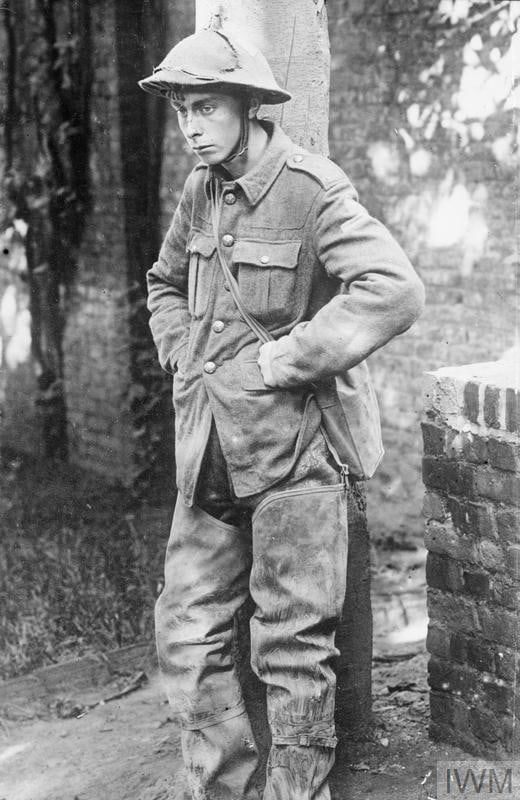
Was war Shell Shock, und wie reagierte die britische Armee darauf?
Shell Shock (Kriegsneurose) war vor dem Ersten Weltkrieg unbekannt. Taylor Downing zeigt, wie er an der Somme ein krisenhaftes Ausmaß erreichte und eine brutale Reaktion der britischen Armee hervorrief, während die Ärzte über die Behandlung uneins waren.
Das Wichtigste in Kürze
- 01Shell Shock war vor dem Ersten Weltkrieg unbekannt.
- 02In der Schlacht an der Somme 1916 erreichte er ein krisenhaftes Ausmaß und rief eine brutale Reaktion der britischen Armee hervor.
- 03Die Ärzte waren über die Behandlung uneins; die Befehlshaber fürchteten, er würde die Moral untergraben.
Aus dem Transkript
I think the principal reason for men being traumatised in the trenches in such large numbers was the power and the intensity of artillery bombardments. … of course men simply couldn't leave their post in the trenches. They just had to hunker down and put up with this continuous, relatively accurate barrage.
And the army held an inquiry, which led to the medical officer Kirkwood being sent home in disgrace, and the survivors being hauled in front of the rest of the division, and on parade, being told that they were cowards … It was a really brutal response from the military.
Three days after the end of the battle, a directive comes down from the top of the medical authorities on the Western Front that the word shell shock is no longer to be used. … But of course, by massaging the figures, by changing the terms used, doesn't actually make the problem go away.
it is absolutely clear that many many of those who were found guilty and those who were shot were suffering from some sort of emotional trauma … I think there's absolutely no question that tragically men were executed shot at dawn as the common phrase is who should have been given medical treatment instead
Vollständiges Transkript (auf Englisch)
Das vollständige Transkript lesen
Musik: Erik Satie’s Je Te Veux (piano/vocal)
Michael Baker
Welcome back to Unknown Warriors with me, Michael Baker. Perhaps because of the way we commemorate the First World War, we tend to associate it with the huge lists of the dead and the missing, their names etched into stone memorials and rows of neatly kept graves. Yet largely forgotten are the many more wounded, most of whom were, of course, also counted as casualties at the time. Among them were men who showed no physical injuries necessarily, but were nevertheless badly scarred psychologically, suffering from a trauma which was then poorly understood and in some quarters found little sympathy. The statistics are not always easy to extrapolate, but it's been estimated that on average, 5.7% of all casualties in the British Army between 1914 and 1918 were psychiatric in nature. But in 1916, this figure rose to a staggering 22.5%. Much of this rise can be put down to the Battle of the Somme. I spoke to the historian Taylor Downing about his recent book called Breakdown, The Crisis of Shell Shock on the Somme, 1916. I began by asking him what had drawn him to the subject and why he'd chosen the particular angle the book focuses on.
Taylor Downing
We tend to see the First World War as a war of mud, trenches of the Western Front, barbed wire of the poets. But in fact, enormous advances in science were made in many different fields, from aerodynamics, aviation, to communications, chemistry, developments in physics, and of course in medicine, both in the treatment of physical wounds and in psychology and psychiatry. And I sort of skimmed the surface of that in the book that I was writing in 2013-2014. That was called Secret Warriors. But I really felt I wanted to drill deeper, and so the book Breakdown very much came out of that research. Quite a lot had been written about shell shock, mostly from the perspective of seeing shell shock as the first step in the long journey that led to what we now call post-traumatic stress disorder, PTSD. That wasn't actually named until after the Vietnam War in 1980. But a lot had been written seeing the sort of evolution of thinking and the reaction to war trauma that starts in the First World War and continues into more recent conflicts. But very little had been written about the military reaction to it at the time in the First World War. And I'm not a scientist myself. I'm not a medical man. I'm not a medical practitioner. So I felt I was not going to be able to write very much or contribute very much to the scientific understanding of what had gone on. So my line was how did the military react to what they perceived as this epidemic of shell shock as it became during the course of the Battle of the Somme. Up until that point, the numbers had been relatively low. It had been a concern. But the numbers reporting with what was called shell shock, that phrase was first used in 1915 by a Dr. Charles Myers, the numbers were relatively low. But that completely was transformed from the 1st of July 1916 onwards with the Battle of the Somme.
Michael Baker
The Battle of the Somme is an iconic, if controversial, battle in the British narrative of the First World War, notorious for the British army incurring its greatest ever losses in a single day, up to 57,000 casualties, of which some 19,000 were deaths. The Somme was a prolonged campaign rather than a battle, lasting over five months from the 1st of July to the 18th of November 1916. By the end, British Empire casualties totaled some 420,000, the French 195,000, with German losses perhaps as high as 600,000. So what was it about this battle that affected the rates of shell shock so dramatically?
Taylor Downing
Well, I think the principal reason for men being traumatised in the trenches in such large numbers was the power and the intensity of artillery bombardments. This was something quite out of line with any previous conflicts. You know, the Battle of Waterloo, for instance, was over in a matter of hours. Even those who'd endured sieges in the Crimean War in the mid-19th century were talking about days. Men in the trenches in the system used by the British army, where they were rotated in and out of the front line, would often endure artillery bombardments for several hours, sometimes several days at a time. The intensity of the experience, the massive destructive capability of the shells that were being used in the First World War, the high explosives that were being thrown around, meant that this was something of a completely new order. And unlike the natural human instinct to get away from a source of danger, of course men simply couldn't leave their post in the trenches. They just had to hunker down and put up with this continuous, relatively accurate barrage. And indeed, every account that I think I've ever read from somebody who lived through the trenches talks about the relentlessness of artillery bombardments, the sound of these shells roaring overhead. Most people say they're like express trains coming past. And everybody describes, everybody who wrote about the First World War, I think I can literally say everybody, I think there'd be very few people who went through the trenches who didn't describe the fact of friends, colleagues, people only a few yards away, being killed or horribly maimed by a shell. But they had survived even a few yards from the centre of the explosion. It was a very, very common and very frightening experience. And this was something pretty new. Certainly the length and the intensity of these bombardments was something quite new to warfare.
Michael Baker
The British expeditionary force that had fought in 1914 and 1915, a mere five divisions totalling 100,000 men, was the smallest big power army on the Western Front, made up of regular soldiers and territorials. It was quickly realised that a mass army would be needed to match the Germans. The result was the very large British army, 52 divisions in all, that engaged in the long Somme offensive of 1916. Two thirds were volunteers, a citizen army, if you like, that included units recruited from the same neighbourhood, known as Pals Battalions.
Taylor Downing
For anybody who reads about the Battle of the Somme, one of the great tragedies is the massive casualty rates amongst the Pals Battalions, the units made up of volunteers who responded to Kitchener's call from the very beginning of the war. I think in the month of September 1914 alone, something like half a million men came forward. By the latter part of 1915, I think it was about one and a half million men had volunteered. My grandfather was actually one of those who had volunteered. And the fact that they're in the front line at the beginning of the assault on the 1st of July meant that their casualty rates were very high. Having said that, there's not very much evidence that the incidence of shell shock was higher amongst the volunteer battalions than amongst the regular battalions, or indeed those of conscript battalions later in the war. The evidence about the numbers is a bit of a murky area because statistics weren't kept in the way they were today. The army didn't actually list the causes of a man's wounds, whether he had a physical wound from a bullet, shrapnel, whether it was an abdominal injury or a head injury, or whether it was some form of nervous shock he was suffering from. This wasn't noted down. So we can't always be absolutely accurate about the figures. And although there was a perception amongst regular army officers that the volunteer battalions were slightly more likely to endure higher rates of shell shock than the regular army battalions, there's not really much evidence to support that. So I don't think the fact that the Somme was fought with volunteers is one of the critical factors in determining the very, very high rate of shell shock experience in the army.
Michael Baker
The last significant British engagement before the Somme was the Battle of Loos, which lasted a mere 20 days in September-October 1915. The Somme was altogether different. It was the first major Allied offensive of the war in which the British army took the brunt of the fighting. And, quite simply, it was on an unprecedented scale.
Taylor Downing
A great deal of attention is always paid, absolutely rightly, to the first day of the Battle of the Somme, the 1st of July 1916, with its horrendous casualty figures, the blackest day of the history of the British army. But remember, the battle went on for another 140 days after that, with regular casualties, or daily casualties, on average, at about 2,500 every day. I mean, numbers that are just impossible to conceive of today. And so I think it was the intensity, it was the fact that the artillery bombardments were built up so heavily on both sides during the course of the Somme that really distinguished it from previous, shorter and less intense battles.
Michael Baker
Lieutenant General Sir John Goodwin, an army surgeon who ended the war as the Director General of the Army Medical Service, later stated his opinion that there were no known cases of shell shock in the British Expeditionary Force that went to France in 1914. His distinction between the professional, regular soldier, and by implication, the less experienced and less resilient citizen volunteer was one widely held in military circles at the time. Is it an assertion that stands up at all?
Taylor Downing
No. There are several cases where very experienced soldiers, soldiers who fought in previous conflicts, like the Boer War, and still suffered from shell shock. There was a sergeant in the rifle brigade who in October 1914 reported in that he wasn't feeling himself. The medical officer, Charles Wilson, examined him, couldn't find anything wrong with him, thought he was just a bit morose, sent him back up to the front. And a couple of days later, he put a revolver to his head and shot himself. That was in October 1914, one of the almost elite regiments in the British Army. So I think right from the beginning of trench warfare, the conditions that were conducive to shell shock was there. But all this really came to a head in the second half of 1916 in the Somme campaign.
Michael Baker
Even the official records, which we know didn't include many obviously psychiatric cases, show that the incidence of shell shock as a proportion of casualties rose at least fourfold during the Somme campaign, compared to the previous six months of the war. It's difficult today to fully understand what these men went through and why they might have been traumatised without looking at the experience of individual units that fought at the Somme. One of these was the Lonsdales, a popular name for the 11th Border Battalion.
Taylor Downing
Well, the Lonsdales, which was a pals battalion, raised in the towns of what today is Cumbria, was then Westmorland, and Cumberland, is a particularly interesting story. Hundreds of volunteers came forward like they were doing across the country, and a lot of these were hard men, miners, farm workers, as well as people who worked in the shops and the workshops in the towns of the area, came forward and formed a pals battalion. They were given the name the Lonsdales because the local Earl of Lonsdale had sort of sponsored them, as it were, had funded their early activities and helped to equip them before the army actually sent them uniforms and so on. They finally got into the front line after a year plus of training in the early months of 1916, and they were positioned on a very tricky part of the Western Front around what was then called the Leipzig Redoubt, which was a very powerful defensive position on the side of a hill just below the village of Thiepval. They were in the second wave that went over the top on the 1st of July 1916 and suffered very, very heavy casualties. The commanding officer was killed, the second-in-commander was killed, most of the company commanders were killed, and several hundred of the men were killed. There were about 250 survivors of the battalion on that first day. Amongst the list of the worst casualty rates, the Lonsdale were up there in the top sort of 30 or 40 battalions. For the week after the 1st of July assault, the failed assault, the survivors were put to burying bodies of their mates, gathering their possessions, sending them back to families. They were constantly under artillery bombardment from the Germans, and then on the 9th of July, they were ordered to go over the top again. And the medical officer, George Kirkwood, we know quite a lot about him, he decided that so many men were reporting with Shellshock or presenting with Shellshock that the unit just wasn't capable of combat action, wasn't capable of going over the top again. He was ignored. The brigadier insisted that they go over the top. The attack completely petered out, had no effect whatsoever. And the army felt now they had to make a stand. They couldn't allow medical officers to overrule combat officers. They couldn't allow units to sort of go down en masse with Shellshock. They had to take a stand to prevent this, because otherwise, the whole effectiveness of the British army as a fighting unit would be reduced. So they initially, they arrested, none of the original officers were still alive, so they arrested a group of NCOs who were charged with cowardly behaviour in the face of the enemy. The general commanding the unit decided to pick on the medical officer, saying that he was far too soft when it came to treating Shellshock. And the army held an inquiry, which led to the medical officer Kirkwood being sent home in disgrace, and the survivors being hauled in front of the rest of the division, and on parade, being told that they were cowards, they'd let themselves down, and they'd let the whole British army down, which for the survivors of one of the worst massacres in military history must have been extraordinarily difficult to take. It was a really brutal response from the military. But the story is sort of at the heart of my book, in a sense, because the book is about how scared the military authorities became. The view was that Shellshock was contagious. It's a strange sort of idea to imagine that a nervous condition could be contagious. But the view was that a nervy man made the other men around him nervous. So the army felt that they had to put a stop to overly sympathetic medical officers and units where the incidence of Shellshock was too high. They felt that there was lots of malingering, that people would see their colleagues, their mates, being sent off for rest and relaxation, taken out of the line, and therefore they would claim to have Shellshock as well. So they saw this whole epidemic sort of getting out of hand very quickly, unless they took a stand. And the story of the Lonsdales is one instance, there are others as well, where the army respond very brutally to the experiences of a unit that had been through the hell of the 1st of July 1916.
Michael Baker
It's pretty clear from this account of the Lonsdales that the military didn't always see eye to eye with the medics. But the medics too, at this date, were divided as to what Shellshock was exactly and how it should be defined. Early in the war, a distinction was made between wounded Shellshock cases, who would be treated properly as if they were physically wounded, and those who were simply sick, who would be returned to their units after rest and recuperation. The division was fairly arbitrary, but it enabled the army to exclude many Shellshock cases from its lists of battle casualties.
Taylor Downing
Every combat unit has its forward psychiatrists that go into action with the men today. But 100 years ago, the Royal Army Medical Corps had no training, no background, no experience in treating nervous conditions at all. And when men started to report with these very strange symptoms, they didn't have physical wounds, but they were shaking, they'd lost their voice, they might have been temporarily blinded, they couldn't walk, they were vomiting quite badly, some of them, these very strange conditions. The medical community couldn't quite decide what this was. And there was a division between those who thought this was actually a physical condition, that the brain had somehow been shaken by the waves of a shell landing nearby. That was one view, and other people in the medical conference said, no, no, this is an emotional reaction, this is a sign of trauma. So the fact that the medical community was divided meant that very different sorts of opinions were going in to the army as to how to treat this. If you can't really agree what's the cause of a condition, then it becomes even more difficult to know quite how to treat it. The treatment that one sees in the First World War ranges from what is today truly barbaric, terrible sort of electric shock, electrotherapy treatments where people were given very, very powerful high voltage shocks shocks to try to stop the physical manifestations of what was happening to them. So the treatments range from that on the one extreme to really quite supportive sort of what we would call psychotherapy, getting people to talk about what had happened to them. A lot of doctors felt that if only we could unlock the trauma that had often been repressed that had happened to a man, if he could confront that and talk about it and be open about it, then he would effectively, and certainly over a period of time, be cured. So there were very different techniques being applied and the army really was in the middle of this. The army had no experience of this, as I've said, and the typical army view was that you were fit and well unless you had a physical malady of some sort, in which case you went to the hospital, got it sorted out, then came back into line. So the idea that people were physically okay but had some nervous condition that disabled them from fighting was not something that easily fit into the military mind. So they're confused by what they see. They're very worried by the increase in the incidence of shell shock during the course of the Battle of the Somme and they're getting very conflicting advice on how to deal with this.
Michael Baker
The British army's ultimate solution to the problem of shell shock, as they saw it, was as brutal as it was simple. If you want something to go away, don't give it a name.
Taylor Downing
Three days after the formal end of the Battle of the Somme, the battle goes on right the way through the summer into the autumn mid to late November 1916. Three days after the end of the battle, a directive comes down from the top of the medical authorities on the Western Front that the word shell shock is no longer to be used. We're going to start a new form of diagnosis. People are going to be sent to specialist centres where only a small number of them will be diagnosed with any sort of nervous condition. Most of them are going to be given a bit of rest, a bit of relaxation, a few days out of the line and then sent straight back to their units. All of this was to be done near the front line. The feeling was that if people were taken back to Britain, away from a military environment to civilian hospitals, then it would take longer for them to recover. So all of this was to happen as near to the front as possible, as near to their battalions, as near to their units as possible. The whole purpose being to get men back into front line duty. And surprise, surprise, what happens in 1917, the numbers supposedly suffering from shell shock drops to almost insignificant numbers. But of course, by massaging the figures, by changing the terms used, doesn't actually make the problem go away. And the evidence is that during 1917, particularly in the Third Battle of Ypres, often known as Passchendaele, where there were some of the worst, most ghastly conditions of the whole of the First World War men had to endure, that the numbers suffering from nervous conditions were just as high as they had been on the Somme, but they weren't reported in the same way. So it's very difficult for us to fully analyse quite the scale of shell shock. But the army congratulated themselves. They'd solved the problem because there were very few people reporting with shell shock or with war trauma.
Michael Baker
Was it also the case, perhaps, that into 1917 and 1918, soldiers simply began to learn to cope better with the stresses of industrialised trench warfare?
Taylor Downing
I don't think there is a sense that men were getting more used to the experience of fighting on the trench warfare. I think the time when we do see a genuine decline in the numbers of war neuroses being reported is in the last few months of the war, when the static trench warfare that had characterised the Western Front from October, November 1914 right up to the mid-summer of 1918, when that finally breaks down and the war becomes a mobile war again, people are covering really quite substantial amounts of ground. The British and the French, supported with the Americans, are advancing quite a long way eastwards into what had been occupied territory. I think then you do see a reduction in the numbers of shell shock because the conditions that I've been describing that were so conducive to shell shock meant hunkering down in trenches with shells being fired at them for hours on end. Those conditions largely came to an end, not that it disappeared altogether, but that the numbers, the incidence, reduced quite substantially.
Michael Baker
At the time, a connection seems to have been made between shell shock and morale. Senior military figures on the Western Front tended to take the view that a well-led and well-organised company or battalion would have correspondingly higher morale and therefore be less susceptible to shell shock.
Taylor Downing
Yes, I think there is some truth in that claim. The association between shell shock and morale was again very strongly felt by the military authorities. A unit that was poorly led and where officers didn't appear to care much for the men's welfare, such units were likely to have a higher incidence of shell shock and I think that that does seem to be the case. I don't think it meant that in well-led units where morale was high there was no shell shock and it didn't always mean the converse that poorly led units had very high levels of shell shock but certainly there is a sort of loose line-up between the figures and I think morale is a factor behind trauma. Not that the best trained men with the highest morale can't suffer at all but again if we're talking numbers and levels of incidence it certainly seems in the First World War that the well-led units had a lower rate.
Michael Baker
So how does the shell shock of the First World War play into how we have come to understand war trauma today?
Taylor Downing
Well a hundred years ago when the First World War was being fought the whole attitude to mental health was very very different to today. Mental health was thought to be some sign of a weakness often an inherited weakness. The terrible phrase was used at the time once a lunatic always a lunatic that if you suffered from some sort of mental health issue it was a sign of deficiency it was a sign of bad breeding all these sort of terrible concepts were associated with mental health issues. Nervous conditions and war trauma were all sort of put into that category. I think now what we can see thank God is a far more liberal attitude towards mental health there's a lot in the news currently about mental health issues but I think the attitude in the army today is almost the opposite of what it was in the First World War. When that war came to an end men were told to go home put all thoughts of the trenches behind them get on with normal life again shut off that sort of box in their mind that dealt with the war a little leaflet that was given to some veterans when they were demobilised simply said if you have any dark thoughts or dark memories go out into the garden look at the flowers growing that'll make you feel better that was the sole advice they were given to cope with what we now know are sort of traumas that linger for a long time sometimes for years sometimes even for decades today the army's view is quite the opposite I've interviewed lots of men who fought in Iraq and Afghanistan they're told talk about it talk about it to your mates talk to your family about it tell them what you've been through don't try and hide it don't try and shut it away talk about it that doesn't mean to say that there is no incidence of trauma amongst veterans today we know there's still alarmingly high levels but nothing like the levels of the first world war
Michael Baker
I asked Taylor finally whether he thought men suffering from shell shock had been shot for cowardice in the first world war
Taylor Downing
yes I think there's no no question in the course of the first world war little less than 3,000 men were found guilty of cowardice in the face of the enemy for which the punishment could be execution about a tenth of them were actually executed the papers of all these trials court-martials some of which only lasted a few minutes the papers were kept secret closed locked away until the 1990s when finally they became available in the National Archives in Kew and when you look through the records of those court-martials it is absolutely clear that many many of those who were found guilty and those who were shot were suffering from some sort of emotional trauma unable to express themselves clearly responding in irrational ways to events around them all of which are sort of very characteristic of war trauma and I think there's absolutely no question that tragically men were executed shot at dawn as the common phrase is who should have been given medical treatment instead
Michael Baker
I've been talking to the historian Taylor Downing about his book Breakdown The Crisis of Shell Shock on the Somme 1916 If you want to know more about Taylor's work or the subject of shell shock in the First World War please follow the links on my website www.unknownwarriorspod.co.uk In the next episode of Unknown Warriors I turn my attention to one of the great gaps in our knowledge and understanding of the First World War namely the Indian contribution one of the largest of the conflict with one and a half million volunteers serving across some 50 countries I hope you'll rejoin me
Musik: Satie’s Je Te Veux
Michael Bakers Erzähltext ist kursiv gesetzt. Dieses Transkript wurde automatisch aus der Tonaufnahme erstellt und kann Fehler enthalten.